

Garnet Beads
Garnet beads are deep red first — almandine and pyrope in wine tones, rhodolite a step toward raspberry — and the same stone runs to cinnamon-orange hessonite, green tsavorite and grossular, and purple. The color is natural and untreated. Faceted garnet beads carry the most light, from 2mm accents to 8mm rounds; smooth rounds read darker and richer, and rough nuggets and chips keep the raw crystal look. Beside carnelian, smoky quartz or gold, garnet is the red a piece is built around.


Green Garnet 10mm Round Beads - 15-16 Inch
Original price
$45.00
-
Original price
$45.00
Original price
$45.00
$45.00
$45.00
-
$45.00
Current price
$45.00
Green Garnet can be among the most valuable of garnets, which come in a variety of colors. Occurring in sizes ranging from a grain of sand to the s...
View full details
Original price
$45.00
-
Original price
$45.00
Original price
$45.00
$45.00
$45.00
-
$45.00
Current price
$45.00


Green Garnet 8mm Round Banded - 15-16 Inch
Original price
$36.00
-
Original price
$36.00
Original price
$36.00
$36.00
$36.00
-
$36.00
Current price
$36.00
Green Garnet can be among the most valuable of garnets, which come in a variety of colors. Occurring in sizes ranging from a grain of sand to the s...
View full details
Original price
$36.00
-
Original price
$36.00
Original price
$36.00
$36.00
$36.00
-
$36.00
Current price
$36.00


Green Garnet 8mm Star Cut Faceted Coin Beads - 15-16 Inch
Original price
$43.00
-
Original price
$43.00
Original price
$43.00
$43.00
$43.00
-
$43.00
Current price
$43.00
Green Garnet can be among the most valuable of garnets, which come in a variety of colors. Occurring in sizes ranging from a grain of sand to the s...
View full details
Original price
$43.00
-
Original price
$43.00
Original price
$43.00
$43.00
$43.00
-
$43.00
Current price
$43.00


Green Garnet 6mm Double Heart Faceted Round Beads - 15-16 Inch
Regular Price
$32.00
Original price
$32.00
-
Original price
$32.00
Original price
$32.00
Current price
$22.00
$22.00
-
$22.00
Current price
$22.00
Green Garnet can be among the most valuable of garnets, which come in a variety of colors. Occurring in sizes ranging from a grain of sand to the s...
View full details
Regular Price
$32.00
Original price
$32.00
-
Original price
$32.00
Original price
$32.00
Current price
$22.00
$22.00
-
$22.00
Current price
$22.00
Sale


Green Garnet 6mm Round Beads - 15-16 Inch
Original price
$19.00
-
Original price
$19.00
Original price
$19.00
$19.00
$19.00
-
$19.00
Current price
$19.00
Green Garnet can be among the most valuable of garnets, which come in a variety of colors. Occurring in sizes ranging from a grain of sand to the s...
View full details
Original price
$19.00
-
Original price
$19.00
Original price
$19.00
$19.00
$19.00
-
$19.00
Current price
$19.00


Green Garnet 4x6mm Faceted Rondelle Beads - 15-16 Inch
Original price
$41.00
-
Original price
$41.00
Original price
$41.00
$41.00
$41.00
-
$41.00
Current price
$41.00
Green Garnet can be among the most valuable of garnets, which come in a variety of colors. Occurring in sizes ranging from a grain of sand to the s...
View full details
Original price
$41.00
-
Original price
$41.00
Original price
$41.00
$41.00
$41.00
-
$41.00
Current price
$41.00


Green Garnet 4mm Faceted Coin Beads - 15-16 Inch
Original price
$18.00
-
Original price
$18.00
Original price
$18.00
$18.00
$18.00
-
$18.00
Current price
$18.00
Green Garnet can be among the most valuable of garnets, which come in a variety of colors. Occurring in sizes ranging from a grain of sand to the s...
View full details
Original price
$18.00
-
Original price
$18.00
Original price
$18.00
$18.00
$18.00
-
$18.00
Current price
$18.00


Green Garnet 4mm Faceted Cube Beads - 15-16 Inch
Original price
$28.00
-
Original price
$28.00
Original price
$28.00
$28.00
$28.00
-
$28.00
Current price
$28.00
Green Garnet can be among the most valuable of garnets, which come in a variety of colors. Occurring in sizes ranging from a grain of sand to the s...
View full details
Original price
$28.00
-
Original price
$28.00
Original price
$28.00
$28.00
$28.00
-
$28.00
Current price
$28.00


Green Garnet 3mm Faceted Round Beads - 15-16 Inch
Original price
$15.00
-
Original price
$15.00
Original price
$15.00
$15.00
$15.00
-
$15.00
Current price
$15.00
Green Garnet can be among the most valuable of garnets, which come in a variety of colors. Occurring in sizes ranging from a grain of sand to the s...
View full details
Original price
$15.00
-
Original price
$15.00
Original price
$15.00
$15.00
$15.00
-
$15.00
Current price
$15.00


Green Garnet 2x4mm Faceted Rondelle AAA Grade Beads - 15-16 Inch
Original price
$34.00
-
Original price
$34.00
Original price
$34.00
$34.00
$34.00
-
$34.00
Current price
$34.00
Green Garnet can be among the most valuable of garnets, which come in a variety of colors. Occurring in sizes ranging from a grain of sand to the s...
View full details
Original price
$34.00
-
Original price
$34.00
Original price
$34.00
$34.00
$34.00
-
$34.00
Current price
$34.00


Green Garnet 3x4mm Faceted Rondelle Beads - 15-16 Inch
Original price
$22.00
-
Original price
$22.00
Original price
$22.00
$22.00
$22.00
-
$22.00
Current price
$22.00
Green Garnet can be among the most valuable of garnets, which come in a variety of colors. Occurring in sizes ranging from a grain of sand to the s...
View full details
Original price
$22.00
-
Original price
$22.00
Original price
$22.00
$22.00
$22.00
-
$22.00
Current price
$22.00


Green Garnet 3mm Table Cut Faceted Cube Beads - 15-16 Inch
Original price
$19.00
-
Original price
$19.00
Original price
$19.00
$19.00
$19.00
-
$19.00
Current price
$19.00
Green Garnet can be among the most valuable of garnets, which come in a variety of colors. Occurring in sizes ranging from a grain of sand to the s...
View full details
Original price
$19.00
-
Original price
$19.00
Original price
$19.00
$19.00
$19.00
-
$19.00
Current price
$19.00


Green Garnet 3mm Banded Faceted Round A Grade - 15 Inch
Original price
$14.00
-
Original price
$14.00
Original price
$14.00
$14.00
$14.00
-
$14.00
Current price
$14.00
Green Garnet can be among the most valuable of garnets, which come in a variety of colors. Occurring in sizes ranging from a grain of sand to the s...
View full details
Original price
$14.00
-
Original price
$14.00
Original price
$14.00
$14.00
$14.00
-
$14.00
Current price
$14.00


Green Garnet 6mm Star Cut Faceted Coin Beads - 15-16 Inch
Original price
$31.00
-
Original price
$31.00
Original price
$31.00
$31.00
$31.00
-
$31.00
Current price
$31.00
Green Garnet can be among the most valuable of garnets, which come in a variety of colors. Occurring in sizes ranging from a grain of sand to the s...
View full details
Original price
$31.00
-
Original price
$31.00
Original price
$31.00
$31.00
$31.00
-
$31.00
Current price
$31.00


Tsavorite 6mm Round A Grade - 15-16 Inch
Original price
$45.00
-
Original price
$45.00
Original price
$45.00
$45.00
$45.00
-
$45.00
Current price
$45.00
Original price
$45.00
-
Original price
$45.00
Original price
$45.00
$45.00
$45.00
-
$45.00
Current price
$45.00


Green Garnet 10mm Round Banded - 15-16 Inch
Original price
$45.00
-
Original price
$45.00
Original price
$45.00
$45.00
$45.00
-
$45.00
Current price
$45.00
Green Garnet can be among the most valuable of garnets, which come in a variety of colors. Occurring in sizes ranging from a grain of sand to the s...
View full details
Original price
$45.00
-
Original price
$45.00
Original price
$45.00
$45.00
$45.00
-
$45.00
Current price
$45.00


Green Garnet 4mm Faceted Round Beads - 15-16 Inch
Original price
$24.00
-
Original price
$24.00
Original price
$24.00
$24.00
$24.00
-
$24.00
Current price
$24.00
Green Garnet can be among the most valuable of garnets, which come in a variety of colors. Occurring in sizes ranging from a grain of sand to the s...
View full details
Original price
$24.00
-
Original price
$24.00
Original price
$24.00
$24.00
$24.00
-
$24.00
Current price
$24.00


Green Tsavorite Garnet 7.5mm Round A Grade - 15-16 Inch
Original price
$51.00
-
Original price
$51.00
Original price
$51.00
$51.00
$51.00
-
$51.00
Current price
$51.00
Garnets are a group of silicate minerals that have been used since the Bronze Age as gemstones and abrasives. All species of garnets possess simila...
View full details
Original price
$51.00
-
Original price
$51.00
Original price
$51.00
$51.00
$51.00
-
$51.00
Current price
$51.00


Hydrogrossular Garnet 10mm Round - 15-16 Inch
Regular Price
$36.00
Original price
$36.00
-
Original price
$36.00
Original price
$36.00
Current price
$25.00
$25.00
-
$25.00
Current price
$25.00
Hydrogrossular garnet is an especially rare gemstone. It's defined by a bright green color, and most commonly found with black inclusions. These in...
View full details
Regular Price
$36.00
Original price
$36.00
-
Original price
$36.00
Original price
$36.00
Current price
$25.00
$25.00
-
$25.00
Current price
$25.00
Sale


Green Garnet 4mm Faceted Round Banded - 15-16 Inch
Original price
$19.00
-
Original price
$19.00
Original price
$19.00
$19.00
$19.00
-
$19.00
Current price
$19.00
Green Garnet can be among the most valuable of garnets, which come in a variety of colors. Occurring in sizes ranging from a grain of sand to the s...
View full details
Original price
$19.00
-
Original price
$19.00
Original price
$19.00
$19.00
$19.00
-
$19.00
Current price
$19.00


Hydrogrossular Garnet 4mm Natural Round - 15-16 Inch
Original price
$18.00
-
Original price
$18.00
Original price
$18.00
$18.00
$18.00
-
$18.00
Current price
$18.00
Original price
$18.00
-
Original price
$18.00
Original price
$18.00
$18.00
$18.00
-
$18.00
Current price
$18.00


Green Garnet 8mm Round - 8-Inch
Original price
$30.00
-
Original price
$30.00
Original price
$30.00
$30.00
$30.00
-
$30.00
Current price
$30.00
Green Garnet can be among the most valuable of garnets, which come in a variety of colors. Occurring in sizes ranging from a grain of sand to the s...
View full details
Original price
$30.00
-
Original price
$30.00
Original price
$30.00
$30.00
$30.00
-
$30.00
Current price
$30.00


Green Garnet 8mm Faceted Rondelle - 8-Inch
Original price
$30.00
-
Original price
$30.00
Original price
$30.00
$30.00
$30.00
-
$30.00
Current price
$30.00
Green Garnet can be among the most valuable of garnets, which come in a variety of colors. Occurring in sizes ranging from a grain of sand to the s...
View full details
Original price
$30.00
-
Original price
$30.00
Original price
$30.00
$30.00
$30.00
-
$30.00
Current price
$30.00


Green Garnet 6mm Round - 8-Inch
Original price
$14.00
-
Original price
$14.00
Original price
$14.00
$14.00
$14.00
-
$14.00
Current price
$14.00
Green Garnet can be among the most valuable of garnets, which come in a variety of colors. Occurring in sizes ranging from a grain of sand to the s...
View full details
Original price
$14.00
-
Original price
$14.00
Original price
$14.00
$14.00
$14.00
-
$14.00
Current price
$14.00


Hydrogrossular Garnet 8mm Round - 15-16 Inch
Original price
$28.00
-
Original price
$28.00
Original price
$28.00
$28.00
$28.00
-
$28.00
Current price
$28.00
Hydrogrossular garnet is an especially rare gemstone. It's defined by a bright green color, and most commonly found with black inclusions. These in...
View full details
Original price
$28.00
-
Original price
$28.00
Original price
$28.00
$28.00
$28.00
-
$28.00
Current price
$28.00


Hydrogrossular Garnet 6mm Round - 15-16 Inch
Original price
$22.00
-
Original price
$22.00
Original price
$22.00
$22.00
$22.00
-
$22.00
Current price
$22.00
Hydrogrossular garnet is an especially rare gemstone. It's defined by a bright green color, and most commonly found with black inclusions. These in...
View full details
Original price
$22.00
-
Original price
$22.00
Original price
$22.00
$22.00
$22.00
-
$22.00
Current price
$22.00


Green Garnet 8mm Round Beads - 15-16 inch
Original price
$32.00
-
Original price
$32.00
Original price
$32.00
$32.00
$32.00
-
$32.00
Current price
$32.00
Green Garnet can be among the most valuable of garnets, which come in a variety of colors. Occurring in sizes ranging from a grain of sand to the s...
View full details
Original price
$32.00
-
Original price
$32.00
Original price
$32.00
$32.00
$32.00
-
$32.00
Current price
$32.00
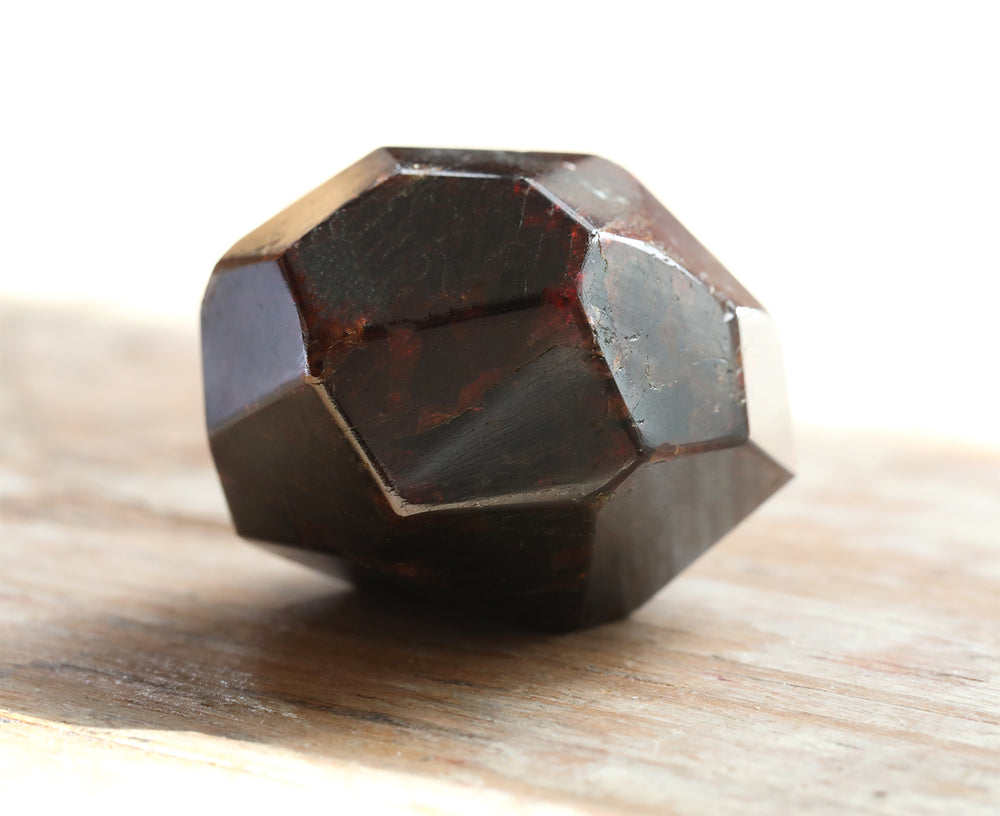
Natural garnet — untreated red, from crystal to strand
Garnet grows as twelve- and twenty-four-sided crystals in metamorphic rock, colored through by the iron and magnesium in its chemistry, so the color needs no help: garnet is one of the few gemstones almost never heated, dyed or oiled, and a strand's deep wine red is the stone's own. That makes the real thing easy to check — garnet is dense and heavy for its size, hard enough to scratch glass, and shows fine needle inclusions where glass shows bubbles. Coated or plated strands are titled as such.
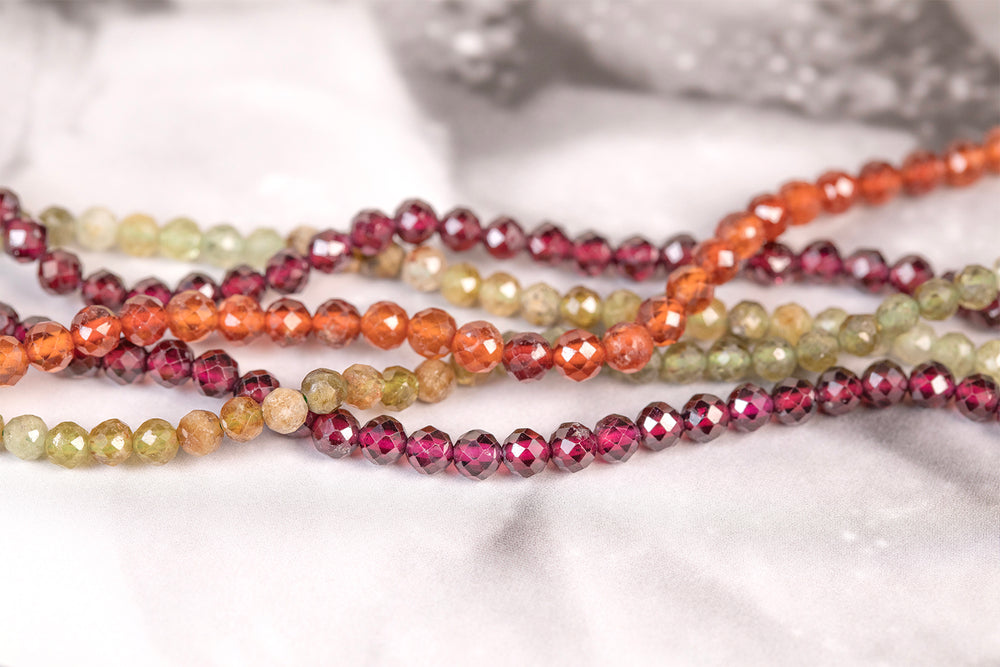
Red, orange and green garnet — almandine, hessonite, grossular, tsavorite
Red is almandine and pyrope, with rhodolite a shade toward raspberry; most strands sold as garnet are almandine. Orange is hessonite, the cinnamon grossular, or spessartine, whose brightest orange is called mandarin garnet, and champagne garnet sits at the pale end. Green is grossular — tsavorite where it is clear and vivid, hydrogrossular where it is opaque, the material sold as African jade — and purple garnet is a pyrope-almandine from Mozambique. The bead trade sells it by color, and all of it is natural and untreated.
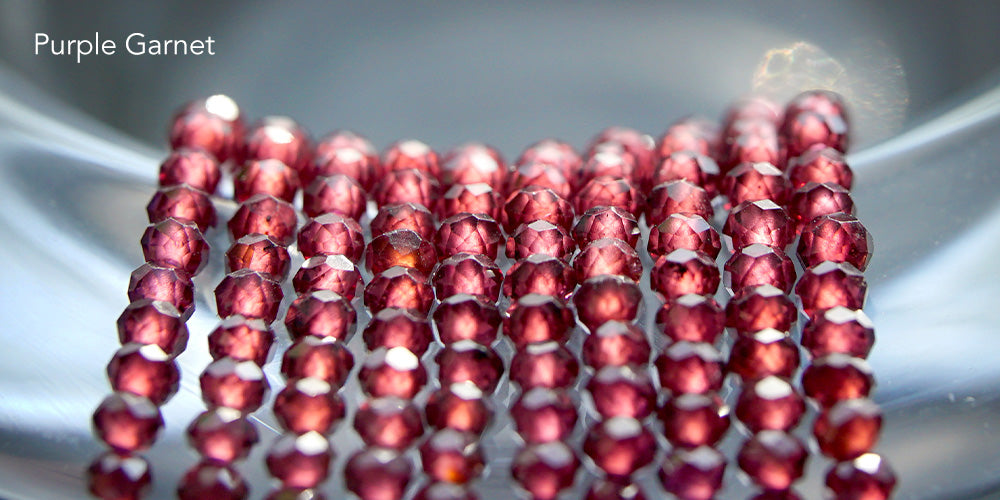
Faceted garnet and smooth rounds — sizes and cuts, 2mm to 10mm
Garnet is hard (Mohs 6.5–7.5) and wears daily: mild soap, a soft cloth, ultrasonic fine for inclusion-free strands. Faceted garnet carries the most light — microfaceted rounds and rondelles at 2mm to 4mm for accents and spacers, faceted rounds to 10mm, coins, table-cut cubes, bicones, energy prisms, hearts, lanterns and rice. Smooth rounds run 3mm to 10mm, 8mm the mala size; large-hole rounds and rondelles at 6mm and 8mm; rough nuggets, pebbles and chips for the raw look. It pairs with carnelian, smoky quartz, clear quartz and gold.
About this stone
Color
RedBurgundyPinkOrangeGreenCinnamon
Origin
IndiaSri LankaMozambiqueMadagascarBrazilUSATanzaniaKenya
Mohs hardness
6.5–7.5
Treatment categories
Natural
Industry-standard treatment
None — garnet is rarely treated
Mineral chemistry
Silicate family (almandine, pyrope, spessartine, grossular, andradite, uvarovite)
Crystal system
Cubic
Stone family
Garnet
Birthstone
January
Common cuts
Faceted RondelleRoundSmoothMicrofaceted Round
Common sizes
2mm3mm4mm6mm8mm
Care notes
Durable across most jewelry applications. Mild soap and soft cloth; ultrasonic generally safe for inclusion-free strands.
Related stones
Ruby, Spinel, Rhodolite (variety), Tsavorite (variety)
Frequently asked questions
-
Is garnet always red?
No. Garnet is a family of related minerals and covers nearly every color. Almandine and pyrope are the deep reds of most bead strands, and rhodolite is raspberry to violet-red. Spessartine is orange, hessonite is cinnamon-orange, and the grossular group runs from clear green tsavorite to the opaque green hydrogrossular sold as African jade. Purple garnet, a pyrope-almandine from Mozambique, is the newest color in beads. A strand sold simply as garnet is almost always red almandine. -
Is garnet treated?
Almost never. Garnet is one of the few colored stones that reaches the market untreated — no heat, no oil, no dye, no filling at trade scale — so the color in a strand is the color the rough came out of the ground with, and it does not fade or rub off. The exceptions are lab-grown or composite material and dyed look-alikes sold under the name, and coated or plated strands, which carry the treatment in their title. Natural garnet is recorded as natural; anything else is labelled where known. -
What is the difference between rhodolite, almandine and pyrope garnet?
All three are red garnets, told apart by chemistry and tone. Almandine is iron-rich, deep wine to burgundy with a brownish undertone at times — the bead-trade default, and what most red garnet strands are. Pyrope is magnesium-rich, a cleaner clear red without the brown, historically the Bohemian garnet of Victorian jewelry. Rhodolite is a pyrope-almandine blend, raspberry to violet-red, lighter and more transparent than either; in beads it is usually sold as red garnet rather than by name. -
How can real garnet beads be told from glass?
Weight, hardness and what is inside. Garnet is dense — noticeably heavy for its size, where glass feels light. At Mohs 6.5–7.5 it scratches glass and shrugs off a steel point. Under a loupe natural garnet shows fine needle or crystal inclusions and a slightly oily brightness from its high refractive index, while glass shows round bubbles and swirl marks. Drill holes on natural stone are clean of dye. Price is the last tell: faceted garnet is not a cheap stone, and strands far below market are glass or dyed quartz. -
What is hessonite garnet?
Hessonite is the cinnamon-orange to honey-brown variety of grossular garnet, most of it from Sri Lanka and India, and one of the two orange garnets in beads; the other is spessartine, whose brightest orange is sold as mandarin garnet. The bead trade sells both as orange garnet, and on a strand they are hard to tell apart — hessonite leans brown-orange with a swirled, treacly look under a loupe, spessartine toward a clearer, brighter orange. Hessonite has come as smooth and faceted rounds from 4mm to 14mm, rondelles, coins, ovals, rectangles and faceted nuggets, on 16-inch and 8-inch strands.