
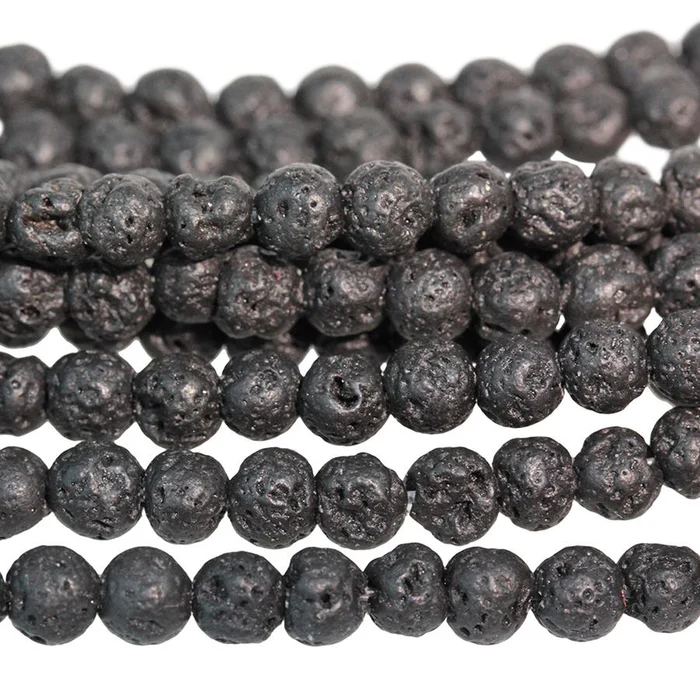
Lava 4mm Round - 15-16 Inch
Original price
$6.00
-
Original price
$6.00
Original price
$6.00
$6.00
-
$6.00
Lava is rock from the molten center of the earth, once spewed through fractures in the planetary crust or from a volcanic eruption. Once cooled, the resulting rock is dark gray to deep black in color and riddled with pits and holes where air was trapped in the stone. It is believed to hold earth and fire energies and to aid in remaining calm and grounded.
SKU LVA4RD
Specifications
Stone type
Volcanic rock
Cut
Round
Bead size
4mm
Strand length
15-16 Inch
Approx. beads per strand
100
Drill style
Center-drilled
Treatment
Natural
Typical origin
IndonesiaIcelandItaly
Mohs hardness
3.5–5
Care
Porous (Mohs 3.5–5) — popular for essential-oil diffuser jewelry. Mild soap and dry thoroughly; avoid soaking.
Mineral family
Volcanic rock
Frequently asked questions
-
What exactly is lava bead material?
Lava beads are cut from basalt, a fine-grained volcanic rock formed when basaltic magma cools rapidly at or near the surface. The signature pitted, vesicular texture comes from gas bubbles trapped during solidification. Mineralogically, basalt is dominated by pyroxene and plagioclase feldspar, often with minor olivine and volcanic glass. Dakota's lava typically comes from volcanic regions including Indonesia, Iceland, and Italy. Because the texture is genuinely porous rather than polished smooth, no two beads pit identically — expect surface variation across a strand, which is part of the look designers reach for. -
Why are lava beads used for essential-oil diffuser jewelry?
The vesicular structure of basalt is genuinely absorbent — the open pits hold a few drops of essential oil and release scent gradually as the oil evaporates. That porosity is the functional draw for diffuser bracelets and necklaces. The tradeoff: the same porosity makes lava sensitive to anything you wouldn't want soaked into the bead. Apply oil to a few beads on the strand rather than saturating the whole piece, let it absorb fully before wearing against skin or light fabric, and avoid layering perfume, lotion, or solvent-based products directly on the beads. -
How durable is lava for everyday wear?
Basalt sits around 3.5–5 on the Mohs scale, which is softer than quartz-family stones and makes lava best suited to earrings, necklaces, and bracelets that don't take constant impact. The porous surface can chip at pit edges if knocked against hard surfaces, and the matte texture will scuff before it polishes. For rings or high-wear bracelets, lava holds up better as an accent bead alongside harder materials than as the dominant stone. Stringing on flexible beading wire or strong cord helps absorb the kind of shock that brittle volcanic rock doesn't love. -
How should I clean lava beads without damaging them?
Keep cleaning minimal and dry. Wipe with a soft cloth to remove skin oils and dust. If beads need more, use a barely-damp cloth with a tiny amount of mild soap, then dry thoroughly — never soak lava, since water (and anything dissolved in it) wicks into the pores and can take days to fully evaporate. Skip ultrasonic cleaners, steam, and chemical jewelry dips entirely. For diffuser pieces, let old essential oil fade naturally between applications rather than trying to wash it out; trapped soap residue is harder to remove than trapped oil. -
How is lava different from obsidian, pumice, or basalt beads?
All four are volcanic, but they behave differently on the bench. Lava beads are basalt with visible vesicular pitting — matte, porous, lightweight. Plain basalt beads are cut from denser, less-vesicular basalt and take a smoother polish without the signature pits. Obsidian is volcanic glass that cooled too fast to crystallize — glossy, conchoidal fracture, harder (around 5–5.5), and not porous. Pumice is so gas-rich it floats and is generally too friable to drill as beads. If a project calls for the textured, oil-absorbing look, lava is the right call; if you want sleek black, obsidian or polished basalt fits better.