

Tourmaline Gemstone Beads
Tourmaline covers a wider range of color than almost any other gemstone — color-zoned multi strands, solid black schorl, and single colors from raspberry pink to indicolite blue. It is the October birthstone, alongside opal.
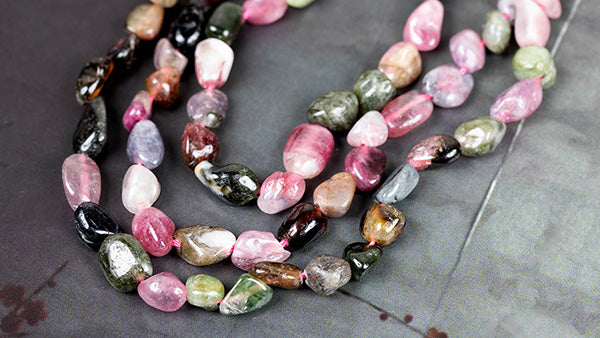
Multi tourmaline is the largest part of the line. A multi strand runs pinks, greens, golds, and plums down its length — tourmaline grows in color zones, so single beads often hold two tones, and no two strands come out the same. Stocked 2mm to 10mm in rounds, coins, rondelles, cubes, hearts, and star cuts, in A and AA grades.
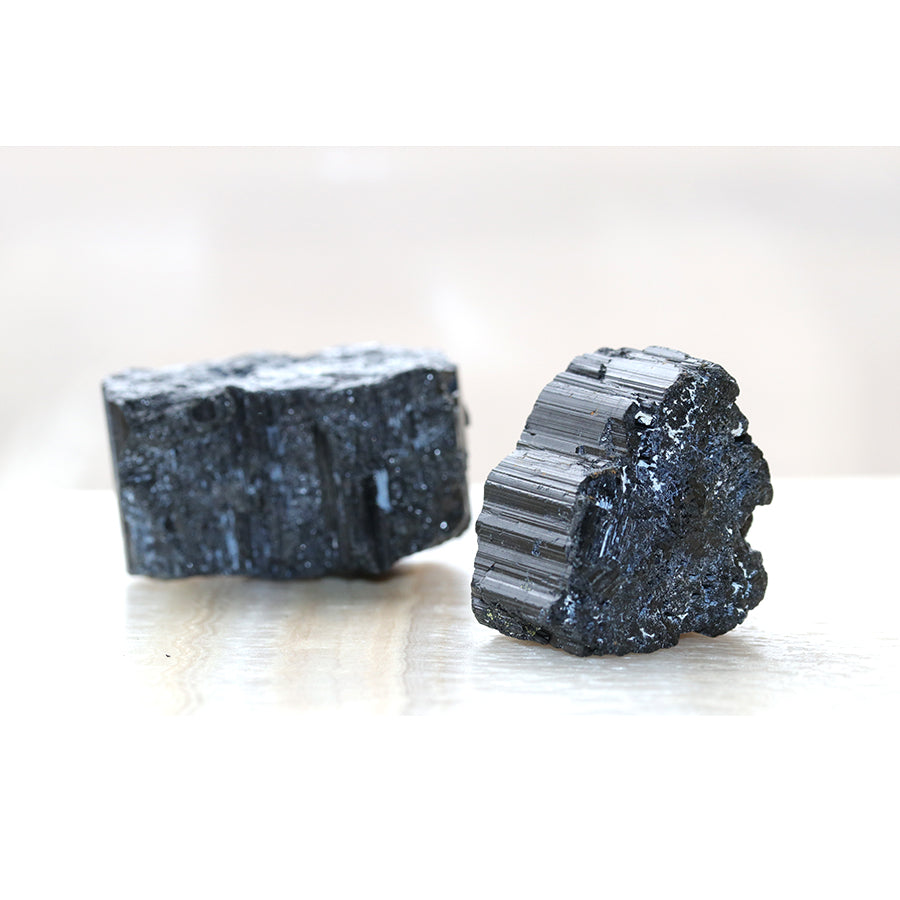
Black tourmaline — schorl — is a true, even black, opaque from bead to bead. The color is the mineral's own; schorl is never treated. In a design it works as the anchor, and it makes a complete strand on its own. Stocked in 4–10mm rounds, including Black Flower rounds patterned with pale mineral inclusions, plus table-cut cubes, graduated nuggets, and top-drilled teeth and drops.
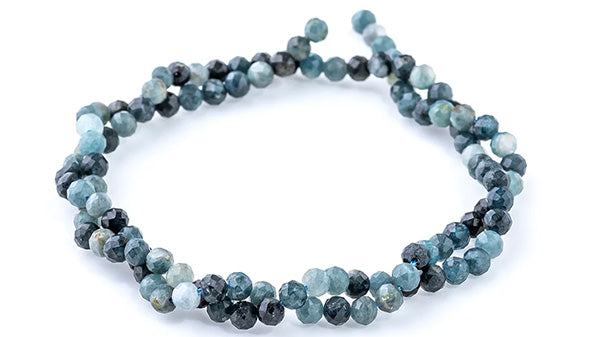
Single-color tourmaline takes one hue at a time. Pink runs pale rose to deep raspberry; green sits in deep bottle tones; plum is a dark red-violet; blue — indicolite — is the rarest of the line, stocked small at 2–4mm. Pink, green, and blue material is routinely heated to clear and steady the color; the treatment is standard and stable. Stocked in faceted rounds, rondelles, cubes, nuggets, and drops. Watermelon tourmaline — a pink core ringed in green — rotates through the line in small lots.
All of it sits at Mohs 7–7.5 and stands up to daily wear — bracelets included.


Yellow Green Banded Tourmaline 3mm Faceted Round - 15-16 Inch
Original price
$38.00
-
Original price
$38.00
Original price
$38.00
$38.00
$38.00
-
$38.00
Current price
$38.00
Tourmaline is classified as a semiprecious stone and occurs in a vast array of colors, everything from colorless to black, from pastel to bright to...
View full details
Original price
$38.00
-
Original price
$38.00
Original price
$38.00
$38.00
$38.00
-
$38.00
Current price
$38.00
Every Color, One Strand
Multi-tourmaline is our signature cut of this stone — strands that run through tourmaline's full color range in a single piece, sometimes color-banded, sometimes gradually variegated bead to bead. No two strands come out quite the same, since the color zoning happens naturally in the crystal. Used whole, a multi strand works as a built-in palette; used sparingly, a single bead can be pulled and echoed in a solid-color piece elsewhere in the design. This is our deepest tourmaline offering — rounds, coins, rondelles, cubes, and more, 2mm to 10mm.
A True Black, With Purpose
Black tourmaline (schorl) is prized for its dense, opaque, true-black color and a slightly greasy luster that reads differently than onyx or black agate under light. It's an anchor stone in design — it grounds a bright palette and holds its own next to silver or gold — and it's just as popular for its holistic reputation: worn as a grounding and protective stone, believed to absorb negative energy, and often reached for to support emotional balance and a sense of stability. At Mohs 7–7.5 it wears well daily. Stocked in 4–10mm rounds, table-cut cubes, graduated nuggets, and top-drilled teeth and drops.
Single-Color Tourmaline
Beyond multi-color and black, tourmaline also comes one color to a strand. Pink runs pale rose to deep raspberry (rubellite at the saturated end); green sits in deep bottle and olive tones (verdelite); blue — indicolite — is the rarest of the line, stocked small at 2–4mm and faceted. Pink, green, and blue material is routinely heat-treated to clear and steady the tone, a stable, industry-standard treatment. These solid strands are the building blocks for designers who want a single, consistent tourmaline color rather than the variation of a multi strand.
About this stone
Color
PinkGreenBlueRedWatermelon (pink-green zoning)BlackMulti-Color
Origin
BrazilMozambiqueNigeriaAfghanistanUSA (Maine, California)Madagascar
Mohs hardness
7–7.5
Treatment categories
NaturalHeated
Industry-standard treatment
Heat treatment for pink, green, and blue varieties
Mineral chemistry
Complex borosilicate (elbaite, schorl, dravite, liddicoatite, uvite)
Crystal system
Trigonal
Stone family
Tourmaline
Birthstone
October
Common cuts
Faceted RondelleMicrofaceted RondelleSmoothSlice (watermelon)
Common sizes
2mm3mm4mm6mm8mm
Care notes
Durable (Mohs 7–7.5). Mild soap and soft cloth; avoid sudden temperature changes.
Related stones
Garnet, Spinel, Aquamarine
Frequently asked questions
-
Is tourmaline real, or is it dyed?
Tourmaline is a single-crystal silicate with characteristic transparency or translucency. Dyed glass, dyed agate, and composite material are sometimes sold as "tourmaline" or "watermelon tourmaline" in the cheap-bead market — those are different categories. Real watermelon tourmaline shows the pink-to-green color transition along a single crystal axis; dyed glass does not. -
Is tourmaline heat-treated?
Often, yes. Pink (rubellite), green (verdelite), and blue (indicolite) tourmaline are routinely heated at 600–700°C to lighten dark material or to clean color tones. The treatment is permanent, stable, and accepted across the global trade. Watermelon tourmaline is typically untreated because the visible color zoning is the buying decision. Black tourmaline (schorl) and chrome tourmaline are almost never treated. -
Is rubellite the same as pink tourmaline?
Yes — *rubellite* is the trade name for saturated red-pink tourmaline. Lighter pink elbaite is generally just called "pink tourmaline." There is no hard chemistry boundary; the distinction is color saturation. -
What is watermelon tourmaline, and is it natural?
Watermelon tourmaline is a single elbaite crystal that grew with a pink core and green rim, sliced perpendicular to the crystal axis to display the color zoning. The zoning is natural — it formed during crystal growth as the trace-element chemistry of the surrounding fluid changed. Watermelon is typically untreated. The zoning has to be both attractive and well-positioned for the slice to show, which is why fully-zoned watermelon is less common than off-zoned material. -
What's the difference between Paraíba and other blue-green tourmaline?
Paraíba tourmaline is copper-bearing tourmaline, producing a uniquely vivid neon blue-green that other tourmaline copper-free chemistries cannot match. The original deposit is in Paraíba State, Brazil (1989); the trade name has since broadened to include copper-bearing tourmaline from Mozambique and Nigeria, which is similar in appearance but typically more available and lower-priced than Brazilian Paraíba. Bead-grade Paraíba is rare; most beads in this color range are African copper-bearing tourmaline.