Product Specifications

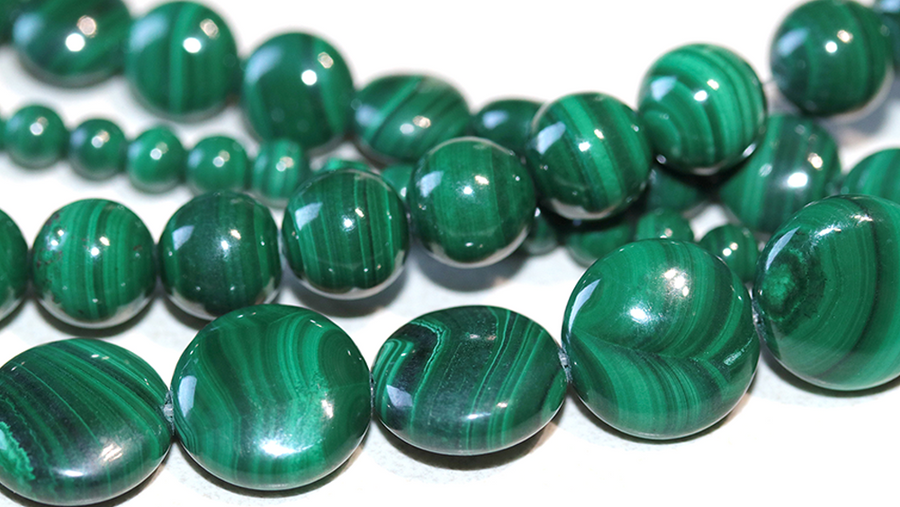
No two beads alike

Is malachite safe to wear?
Pairs well with
Pairs with Lapis
Complete the pairing
Shop Pairs with Lapis
Choose a size and finish to complete the pairing.
Lapis 8mm Round Large Hole 8-Inch
Lapis is a semi-precious stone and one of the most sought after throughout history. It is highly regarded for its beautiful blue color flecked with...
View full detailsLapis 8mm Round - 8-Inch
Our Lapis is 7-8mm in diameter. Lapis is a semi-precious stone and one of the most sought after throughout history. It is highly regarded for its b...
View full detailsLapis 4mm Round - 15-16 inch
Lapis is a semi-precious stone and one of the most sought after throughout history. It is highly regarded for its beautiful blue color flecked with...
View full detailsLapis 6mm Round 8-Inch
Lapis, or Lapis Lazuli, is a deep blue metamorphic rock used as a semi-precious stone that has been prized since antiquity for its intense color. D...
View full detailsLapis A Grade 6mm Round - 15-16 Inch
Lapis is a semi to precious stone and one of the most sought after throughout history. It is highly regarded for its beautiful blue color flecked w...
View full detailsLapis 12mm Coin 8-Inch
Lapis, or Lapis Lazuli, is a deep blue metamorphic rock used as a semi-precious stone that has been prized since antiquity for its intense color. D...
View full detailsLapis 8mm Round Faceted Large Hole Bead 8-Inch
Lapis is a semi to precious stone and one of the most sought after throughout history. It is highly regarded for its beautiful blue color flecked w...
View full detailsLapis 4mm Round 8-Inch
Lapis, or Lapis Lazuli, is a deep blue metamorphic rock used as a semi-precious stone that has been prized since antiquity for its intense color. D...
View full detailsLapis A Grade 8mm Round - 15-16 Inch
Lapis is a semi to precious stone and one of the most sought after throughout history. It is highly regarded for its beautiful blue color flecked w...
View full detailsFrequently asked questions
-
Is malachite safe to work with at the bench?
Finished, polished malachite beads are safe to handle and wear. The caution applies to fabrication: malachite is basic copper carbonate, and copper carbonate dust is toxic if inhaled. Avoid grinding, sanding, drilling, or reshaping malachite beads dry. If you need to modify a bead, work wet and wear a respirator, or substitute a harder stone. Routine stringing, knotting, and wire-wrapping pose no exposure risk because no dust is generated. Wash hands after extended handling of raw or chipped material, and don't put broken pieces in your mouth to hold while working. -
What does "waxed" or "stabilized" mean on malachite beads?
Malachite is soft (Mohs 3.5–4) and porous along its banding, so a surface wax or resin pass is common to seal the polish and reduce micro-chipping at the drill holes. Waxing is a light surface treatment; stabilization pushes resin deeper into the stone. Both are accepted trade practice for malachite and don't change the mineral. They do mean you must avoid heat, solvents, and ultrasonic cleaners — those strip wax and can cloud resin. Treatment should be disclosed; ask before buying if it isn't specified. -
What jewelry projects suit malachite best?
Earrings, pendants, and necklaces are the sweet spot. The banded green reads beautifully in larger smooth rounds (8–12mm) where the concentric pattern shows, and in cabochons set as focal pieces. Faceted cuts catch light differently and play down the banding if you want a more uniform look. Skip malachite for rings and bracelets that take daily knocks — at Mohs 3.5–4 it scratches and chips against harder stones and metal findings. Pairs well with brass, copper, and warm-toned metals; also with pearl, lapis, and coral for classic high-contrast palettes. -
How should finished malachite jewelry be cleaned and stored?
Mild soap, lukewarm water, and a soft cloth — nothing more. No ultrasonic, no steam, no jewelry dips, no ammonia or acidic cleaners; all of these will damage the surface or strip wax. Dry promptly and don't soak. Store malachite separately from harder stones (quartz, topaz, agate) in a soft pouch so it doesn't get scratched in a shared box. Keep it away from prolonged sun and heat, which can dull the polish over time. Remind retail customers to put jewelry on last, after lotion, perfume, and hairspray. -
How do I tell malachite from azurite, chrysocolla, or look-alikes?
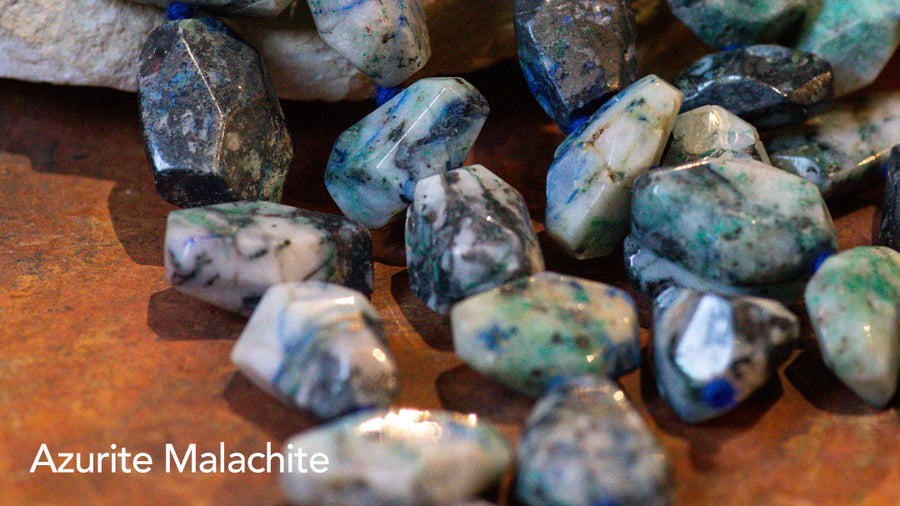
All three are copper minerals and often occur together, which is why they get confused. Malachite is opaque green with distinctive concentric or banded light-and-dark green patterns. Azurite is deep blue and frequently appears intergrown with malachite as "azurite-malachite." Chrysocolla is blue to blue-green, usually more mottled than banded, and is often stabilized in quartz for durability. Beware reconstituted or block "malachite" — uniform color with no banding, or banding that looks printed rather than concentric, suggests composite material. Genuine malachite shows variation strand to strand because the banding depends on how the bead was cut from the nodule.