

Tiger Eye Gemstone Beads
Tiger Eye is a stone celebrated for its unique optical reflectance. Scientifically known as a chatoyant gem, Tiger Eye is formed primarily from silicon dioxide and gets its silky, lustrous stripes from the parallel intergrowth of quartz crystals and altered amphibole fibers that have been replaced by silica. The golden yellow and rich brown hues that define Tiger Eye are a result of iron oxide deposits, rendering it as much an artwork of nature as a mineral wonder.
Facts: Tiger Eye was highly valued by ancient civilizations for its supposed protective properties and its enigmatic appearance. Egyptian pharaohs were often buried with an amulet of this alluring stone, believing it to offer psychic protection and to grant the power of keen insight and enhance divine vision. Its mesmerizing appearance has made it a staple in decorative ornaments and jewelry through the ages, retaining a prominent status among gems worldwide.
Metaphysical / Holistic: Tiger Eye is thought to ground and protect while enhancing confidence and strength of will. It encourages clarity of intention and resonates with the solar plexus chakra, promoting personal empowerment and spiritual growth.


Tiger Eye 7x8mm Faceted Rice Bead A Grade - 15-16 Inch
Original price
$18.00
-
Original price
$18.00
Original price
$18.00
$18.00
-
$18.00
Tiger Eye is a macrocrystalline Quartz stone with bands of rich golds and browns. Its chatoyant layers that create a flash which seems to emanate f...
View full details
Original price
$18.00
-
Original price
$18.00
Original price
$18.00
$18.00
-
$18.00
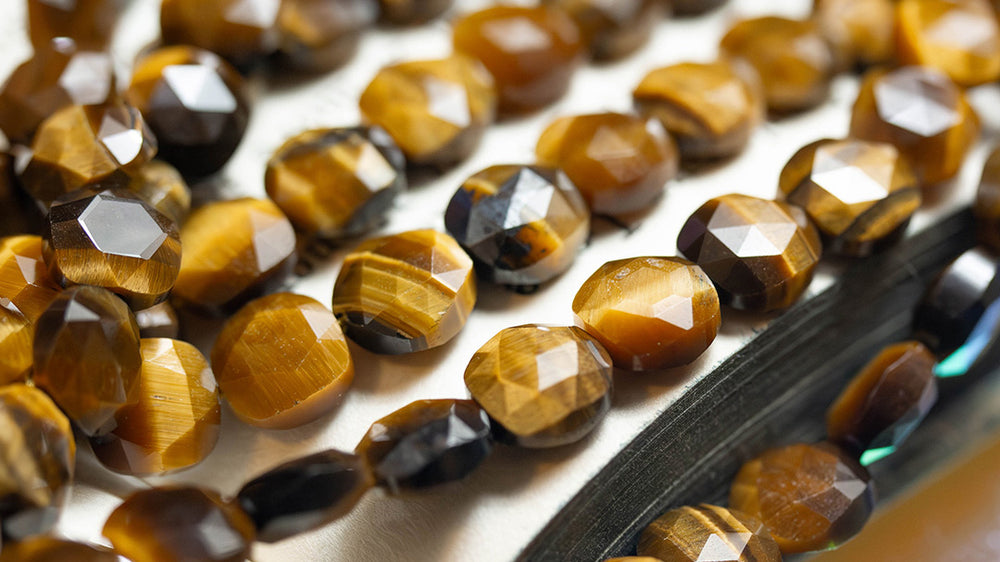
The band of light that moves
Tiger eye's signature is chatoyancy — a silky band of light that slides across the surface as the bead turns, like the slit pupil of a cat's eye. It comes from fine parallel fibers locked inside the quartz, and it's completely natural. At rest the stone is a warm gold-and-brown; tip it toward the light and a bright ribbon travels across each bead. Like labradorite's flash, it's something you really have to see move.
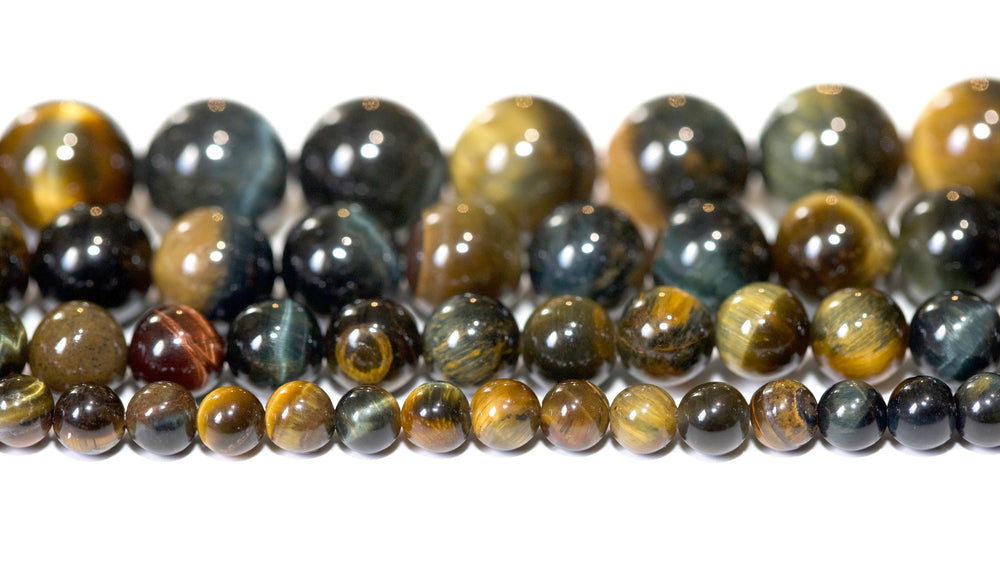
Gold, red, and blue — what's natural
Classic golden-brown tiger eye and blue tiger eye (also called hawk's eye) are natural colors. Red tiger eye is gently heat-treated — a stable, permanent change that deepens the brown to a rich mahogany red. Brightly dyed tiger eye in non-natural colors does exist in the market; we stick to the natural and heat-finished tones, so the chatoyant shimmer always reads true. Whichever color you choose, the moving band of light is the same.
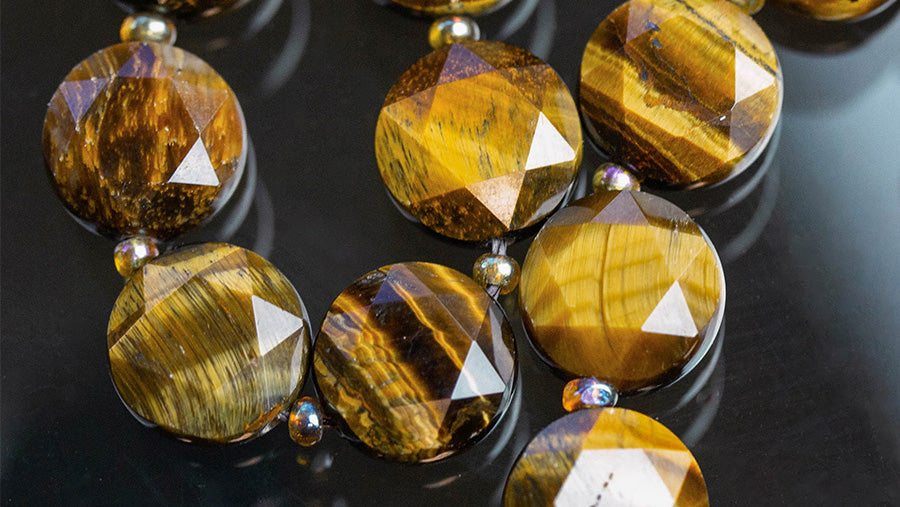
Pick your size and cut
Tiger eye is durable enough for everyday wear (Mohs 5.5–6) — wipe it with mild soap and a soft cloth. It's stocked in rounds, faceted rounds, and rondelles from 4mm through 10mm, so you can match a finished piece or build a graduated set in one order. The chatoyancy reads strongest on smooth, domed rounds. It pairs naturally with carnelian, onyx, and smoky quartz.
About this stone
Color
GoldBrownHoneyRedBlue
Origin
South AfricaAustraliaNamibiaIndiaUSA
Mohs hardness
5.5–6
Treatment categories
NaturalHeated
Industry-standard treatment
Red tiger eye is heat-treated; natural gold/brown and blue (hawk's eye) are typically untreated
Mineral chemistry
Silicified crocidolite — parallel quartz fibers replacing amphibole, with iron oxide producing color
Crystal system
Trigonal
Stone family
Quartz
Common cuts
RoundFaceted RoundRondelle
Common sizes
4mm6mm8mm10mm
Care notes
Moderate hardness (Mohs 5.5–6). Mild soap and soft cloth.
Related stones
Hawk's Eye, Pietersite, Cat's Eye
Frequently asked questions
-
Is red tiger eye natural or treated?
Red tiger eye is heat-treated. Controlled heating of natural golden tiger eye converts the iron-oxide content to a deeper red-brown color while preserving the chatoyant band. This is a long-established and widely-accepted trade practice — not considered deceptive when disclosed. Heat treatment should be disclosed; ask before buying if a strand doesn't specify. Golden tiger eye and blue tiger eye / hawk's eye are sold natural. -
What's the difference between blue tiger eye and hawk's eye?
Mineralogically, they are the same material — hawk's eye is the proper name for the chatoyant silvery-blue stone whose amphibole fibers haven't yet fully oxidized to the golden tiger eye color. "Blue tiger eye" is the trade marketing name; both terms refer to the same stone. Sold natural; the blue-gray color and the chatoyant band are intrinsic. -
Is tiger eye dyed?
Most tiger eye is not dyed. Golden tiger eye is sold natural, red tiger eye is heat-treated (not dyed), and blue tiger eye / hawk's eye is sold natural. Bright unnatural saturations sold under the tiger eye name — electric blue, neon green, magenta — are dye signals and uncommon in the variety. Treatment should be disclosed per SKU; ask before buying if it isn't specified. -
How durable is tiger eye for daily wear?
Mohs 6.5–7. Durable enough for any jewelry application including rings and bracelets. Standard care: soft cloth with mild soap. The fibrous structure means surface scratches show more readily along the fiber direction; store separately from harder stones to extend polish life. Heat-treated red strands are stable but benefit from gentle cleaning rather than aggressive solvents. -
What sizes and cuts does Dakota carry?
Active inventory centers on 6mm and 8mm rounds, with 4mm, 10mm, 12mm, and 14mm rounds also stocked. The catalog spans all three principal color registers — golden/brown, red (heat-treated), and blue / hawk's eye — across rounds, rondelles, faceted cuts, and matte finishes. Full size and cut availability is filterable in the grid above; exact strand specifications appear on each listing.