Skip to content

Multi Tourmaline 10mm Round Large Hole Beads - 8-inch

Original price $27.00 - Original price $27.00
Original price $27.00
$27.00
$27.00 - $27.00
Current price $27.00

Tourmaline is classified as a semiprecious stone and occurs in a vast array of colors, everything from colorless to black, from pastel to bright to dark. It can even exhibit various colors within the same specimen. Its name derives from the Sinhalese word “turamali,” which translates to “stone of many colors.” Due to this variety of colors, Tourmaline has often been confused with other stones. Many stones in the Russian crown jewels from the 17th century which were thought to be rubies are actually red Tourmaline.

SKU TML10RDLH-8
Product Specifications

Stone type
Tourmaline
Cut
Round
Bead size
10mm
Strand length
8 Inch
Approx. beads / strand
17
Drill style
Center-drilled
Hole size
2.5mm
Mohs hardness
7–7.5
Mineral family
Tourmaline
Treatment
Natural
Typical origin
BrazilMozambiqueNigeriaAfghanistanUSA (Maine, California)Madagascar
Care
Durable (Mohs 7–7.5). Mild soap and soft cloth; avoid sudden temperature changes.
Every Color, One Strand

Every Color, One Strand

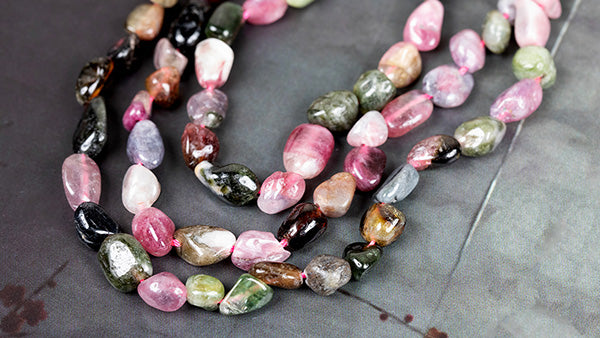
Multi-tourmaline is our signature cut of this stone — strands that run through tourmaline's full color range in a single piece, sometimes color-banded, sometimes gradually variegated bead to bead. No two strands come out quite the same, since the color zoning happens naturally in the crystal. Used whole, a multi strand works as a built-in palette; used sparingly, a single bead can be pulled and echoed in a solid-color piece elsewhere in the design. This is our deepest tourmaline offering — rounds, coins, rondelles, cubes, and more, 2mm to 10mm.
A True Black, With Purpose

A True Black, With Purpose

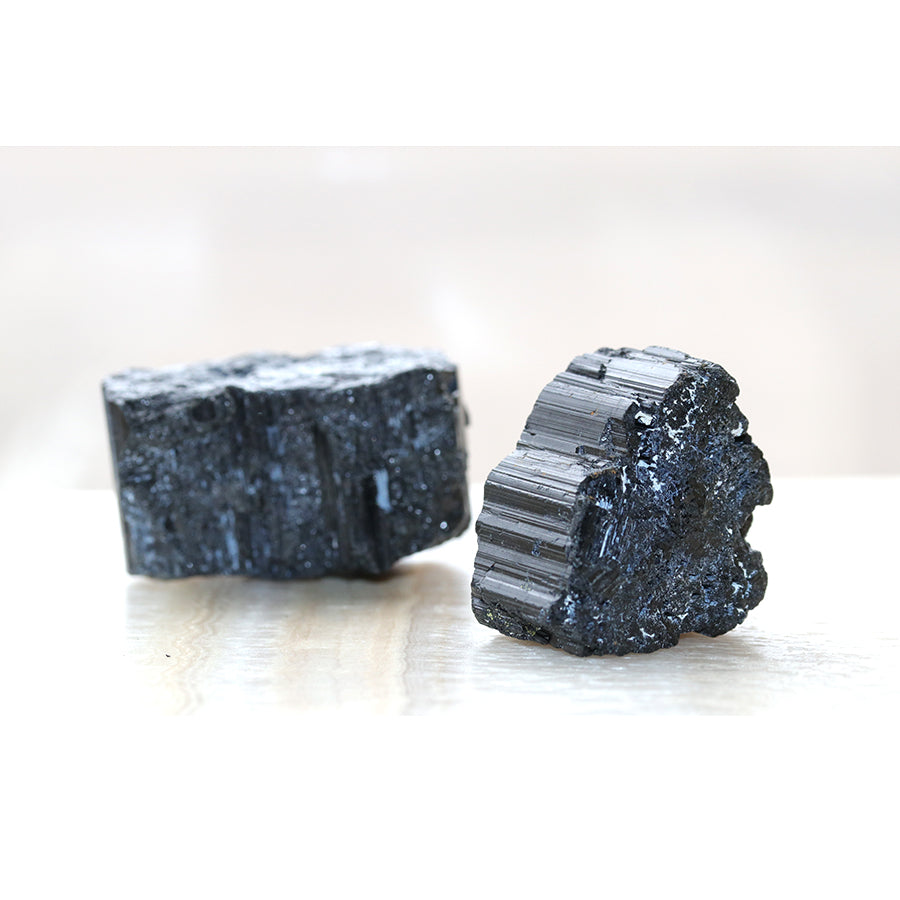
Black tourmaline (schorl) is prized for its dense, opaque, true-black color and a slightly greasy luster that reads differently than onyx or black agate under light. It's an anchor stone in design — it grounds a bright palette and holds its own next to silver or gold — and it's just as popular for its holistic reputation: worn as a grounding and protective stone, believed to absorb negative energy, and often reached for to support emotional balance and a sense of stability. At Mohs 7–7.5 it wears well daily. Stocked in 4–10mm rounds, table-cut cubes, graduated nuggets, and top-drilled teeth and drops.

Frequently asked questions

  • What color varieties of tourmaline might I see across this collection?
    Tourmaline is a group of related borosilicate minerals, and color depends on which species is present. Black tourmaline is schorl; pink and red are rubellite (elbaite); blue is indicolite; green is verdelite; brown to golden is dravite; and watermelon tourmaline shows pink cores with green rims in a single crystal. Multi-color strands and mixed-tone parcels are common because rough is often cut from zoned material.
  • Is tourmaline typically treated, and what should I expect?
    Tourmaline is often sold natural, but heating is a long-accepted trade treatment used to lighten or clarify color in some material — particularly to improve blues and greens or reduce brownish overtones. Heat-treated tourmaline is stable and does not require special care beyond the usual guidance for the stone.
  • How do I tell tourmaline apart from garnet, spinel, or aquamarine?
    In bead form, the easiest tells are color zoning and pleochroism: tourmaline frequently shows visible color shifts along the length of a crystal, and faceted beads often display two distinct tones when rotated. Garnet tends toward uniform deep red with no pleochroism; spinel is singly refractive and usually evenly colored; aquamarine is lighter, cooler, and a different crystal habit. Tourmaline's trigonal structure also produces the characteristic elongated rough that's often retained in tube or barrel cuts. When in doubt, the mineral species listed is the reference.
  • What jewelry projects suit tourmaline best?
    At Mohs 7–7.5, tourmaline holds up well across most jewelry categories — earrings, necklaces, bracelets, and occasional-wear rings. The small calibrated sizes Dakota stocks heavily (2mm, 3mm, 4mm in microfaceted and faceted rounds) are well-suited to delicate beaded chains, multi-strand layouts, spacer accents between larger focal stones, and beadweaving where a touch of natural color sparkle helps. Larger 6–10mm rounds and rondelles work for statement strands and knotted designs. Watermelon and multi-color strands pair cleanly with neutral metals; saturated rubellite or indicolite holds its own next to diamond or pearl accents.
  • How should finished tourmaline jewelry be cared for?
    Clean with mild soap and a soft cloth or soft brush, then rinse and pat dry. Avoid ultrasonic and steam cleaners — tourmaline can carry internal inclusions or fractures that respond poorly to vibration and thermal shock, and pyroelectric properties mean the stone holds static charge that attracts dust. Skip prolonged exposure to harsh chemicals, chlorinated water, and sudden temperature changes. For rings, the 7–7.5 hardness is workable but not ideal for daily heavy wear; bezel or protective settings extend service life. Store separately from harder stones like sapphire, topaz, and quartz to prevent scratching.