Carnelian Pebble Specimen 40x60mm (75-90 grams) - DS ROCK SHOP
Whether you're drawn to it's beauty or you are a collector of cool rocks, this beautiful Carnelian rock specimen is perfect for gift giving or keep for yourself! Sweet and soft pink, you can't help but feel the love when it's near you! It's a beautiful specimen!
Carnelian crystal is here to fill us full of courage and to help us attract all the delights of love and life we so deserve. It is an energy booster, and it can stabilize your energy as well. When it is placed in a room, it can increase the energy flow in the room. It turns the energy into a peaceful warm and secure strength. Just like its sunset orange colors, users have reported feeling peacefully warm and joyful on using this stone in their homes. Carnelian also soothes lower back problems and helps with symptoms of depression.
The measurements and weights are approximate. Since this is a natural stone, each specimen will vary in size and shape. Yours is truly one-of-a-kind!
Carnelian is said to be the Restorative Stone.
Promotes:
- Rebirth
- Motivation
- Creativity
Stone Description -
Carnelian is a glassy, translucent stone that can appear with such bright orange hues that the ancient Egyptians called it “the setting sun.” Most deep red Carnelian has been heat treated to darken the beautiful orange and red tints that are created by iron oxides in the stone. Ancient warriors wore Carnelian for courage and power, and it has been used throughout history for various purposes, including to ward off illness and the Plague.
Stone Type: Carnelian
Origin: Brazil, India, Australia, Russia, Madagascar, South Africa, Uruguay and USA
Approximate Size: 1.6x2.4 Inches / 40x60mm / 4x6cm
Weight: grams:75-90 grams
Item Type: Specimen
Specifications
Frequently asked questions
-
Is carnelian commonly heat-treated, and does that affect durability?
Most commercial carnelian on the market has been heat-treated to deepen and stabilize the orange-to-red color. Heating is a long-standing, accepted practice in the chalcedony trade and doesn't compromise the stone's structural integrity — heated carnelian wears the same as unheated material at Mohs 6.5–7. Some strands are dyed rather than heated, which can fade with prolonged UV or solvent exposure. Treatment should be disclosed — ask before buying if it isn't specified. For pieces sold as natural carnelian, expect more variation in tone, from pale peach to deep red-brown within a single strand. -
How do I tell carnelian apart from sard, sardonyx, and agate?
All four are chalcedony — the differences are color and banding. Carnelian runs orange to red-orange, colored by iron oxide. Sard is darker, leaning red-brown to nearly black-brown; the line between deep carnelian and sard is fuzzy and trade usage varies. Sardonyx shows parallel bands of sard alternating with white or lighter chalcedony. Agate is the umbrella term for banded chalcedony and is usually identified by visible concentric or irregular banding. A solid-color orange bead with no banding is carnelian; add brown bands and it becomes sardonyx territory. -
What jewelry projects does carnelian work best in?
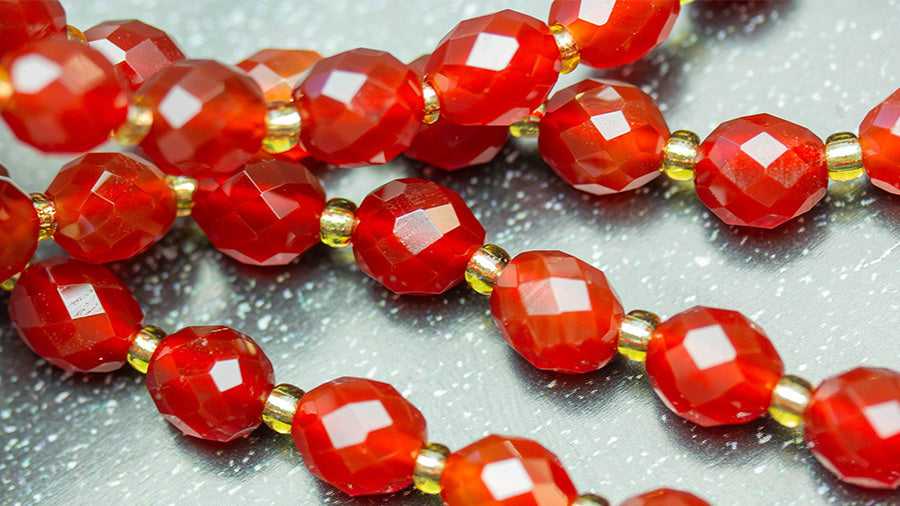
At Mohs 6.5–7, carnelian is durable enough for nearly any jewelry application, including rings and bracelets that see daily wear. The warm orange-red palette pairs cleanly with brass, copper, antiqued bronze, and yellow gold; it also bridges well to turquoise, lapis, and onyx in southwestern and bohemian designs. Smaller rounds (4–6mm) work for delicate strands, layering necklaces, and mala-style malas. Larger rounds (8–12mm), coins, and ovals make strong statement focals. Faceted cuts amplify the translucency in better-grade material — useful when you want the stone to catch light rather than read as a flat color block. -
Will carnelian fade over time?
Heat-treated carnelian is color-stable and won't fade under normal wear, including sunlight exposure — the iron oxide chromophore is part of the stone's chemistry. Dyed carnelian is a different story: surface or fracture-filled dye can lighten with prolonged UV, sweat, perfume, or solvent contact. If color longevity matters for a piece, check whether the strand is listed as heated/natural versus dyed. For finished jewelry, storing pieces away from direct sun when not worn and avoiding ultrasonic cleaning on dyed material extends color life. -
How should I clean carnelian beads and finished pieces?
Warm water, mild soap, and a soft cloth or soft brush handle routine cleaning. Carnelian's hardness (6.5–7) and lack of cleavage make it tolerant of ultrasonic cleaners for untreated and heat-treated material — though if the strand is dyed or you're unsure of treatment, skip the ultrasonic to avoid loosening surface color. Avoid prolonged exposure to bleach, acetone, and harsh jewelry dips, which can dull polish on chalcedony. Steam cleaning is generally fine for stable material. Dry beads fully before restringing on silk or other natural fiber cords to prevent mildew.