

Carnelian Gemstone Beads
Carnelian boasts a vibrant range of colors from pale orange to deep red, classified scientifically as a variety of chalcedony, which is a mineral of the quartz family. Carnelian's unique coloration is due to the presence of iron oxide impurities within the clear quartz. These beads are often smoothly polished to highlight their glassy luster and rich color.
Facts: Carnelian has a storied history and is believed to have been used as far back as 3000 BC. Ancient warriors wore carnelian around their necks for courage and physical power to conquer their enemies. In Egypt, it was worn by master architects to show their rank of builder, and it is said to have been used to protect the dead on their journey to the afterlife.
Metaphysical / Holistic: Historically renowned for its protective qualities, Carnelian is said to inspire courage and boost creativity in those who wear it. Its association with the sacral chakra promotes the zest for life, empowerment, and stimulates creativity, making it perfect for artists and designers.


Carnelian 6mm Round - Large Hole Beads
Original price
$9.00
-
Original price
$9.00
Original price
$9.00
$9.00
-
$9.00
Carnelian is a glassy, translucent stone that can appear with such bright orange hues that the ancient Egyptians called it “the setting sun.” Most ...
View full details
Original price
$9.00
-
Original price
$9.00
Original price
$9.00
$9.00
-
$9.00


Carnelian 6mm Faceted Round - Large Hole Beads
Original price
$12.00
-
Original price
$12.00
Original price
$12.00
$12.00
-
$12.00
Carnelian is a glassy, translucent stone that can appear with such bright orange hues that the ancient Egyptians called it “the setting sun.” Most ...
View full details
Original price
$12.00
-
Original price
$12.00
Original price
$12.00
$12.00
-
$12.00
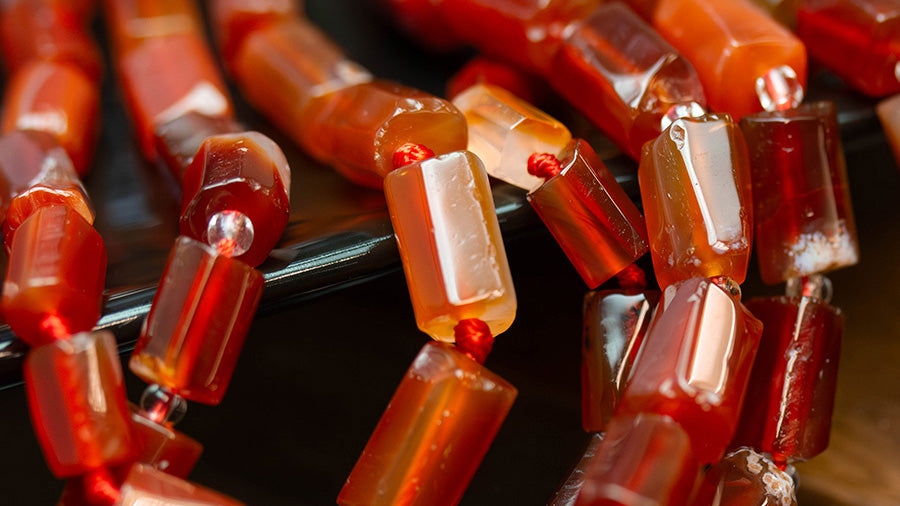
Warm orange-red, lit from within
Carnelian is a translucent chalcedony in warm tones — orange, red, and amber-brown — that seems to glow when light passes through it. The color ranges from soft peachy orange to deep brick red, sometimes shading across a single strand. That warm translucency is what designers love: it reads rich and autumnal, and it flatters warm metals and earthy palettes.

Why faceted carnelian catches the light
Carnelian is translucent, so faceting does real work. Each cut bends the light passing through the bead and throws it back — that's the bright sparkle and the deeper, more saturated orange-red a smooth round can't give you. The glow comes from inside the stone, not off its surface, which is exactly why translucent material like carnelian rewards faceting more than an opaque stone would. Reach for faceted when a piece needs presence; smooth rounds give a softer, everyday warmth. Two finishes, two jobs.

Pick your size and cut
Carnelian is hard-wearing (Mohs 6.5–7) and easy to live with — wipe it with mild soap and a soft cloth, and ultrasonic cleaning is generally safe. It's stocked in rounds, rondelles, and faceted rondelles from 4mm through 10mm, so you can match a finished piece or build a graduated set in one order. It pairs naturally with tiger eye, smoky quartz, and other warm stones.
About this stone
Color
OrangeRedBrown
Origin
BrazilIndiaMadagascarUruguayUSA
Mohs hardness
6.5–7
Treatment categories
HeatedDyedNatural
Industry-standard treatment
Heat treatment to deepen orange-red color is industry standard; natural untreated stones are also available
Mineral chemistry
Microcrystalline quartz (chalcedony) colored by iron oxide impurities
Crystal system
Trigonal
Stone family
Chalcedony
Common cuts
RoundFaceted RondelleRondelle
Common sizes
4mm6mm8mm10mm
Care notes
Durable (Mohs 6.5–7). Mild soap and soft cloth; ultrasonic generally safe.
Related stones
Sard, Sardonyx, Agate, Chalcedony
Frequently asked questions
-
Is carnelian heat treated?
Most carnelian in the bead market is heat-treated, and a meaningful portion of Dakota's active carnelian catalog is heated material. Heat treatment is industry-standard for the variety — gentle heating deepens the iron-oxide color already present in the rough, producing the saturated orange-to-red register designers associate with carnelian. The treatment is permanent and stable; the color doesn't fade with wear. Heat treatment is accepted across the trade similar to the heating that produces most commercial citrine. Treatment status should be disclosed per strand. -
Is carnelian dyed?
Some carnelian in the trade is dyed chalcedony or dyed agate brought to the orange-red register. Roughly half of Dakota's active carnelian catalog is dyed material; the other half is heated. Both are legitimate stocked products when disclosed. The visual difference between heated and dyed strands is subtle and not always reliable from photos — the surest path is the product-page treatment field. Ask before buying if it isn't specified. -
What's the difference between carnelian and sard?
Both are iron-oxide-colored chalcedony in the warm register. Carnelian is the term used for the brighter orange-to-red end; sard refers to the darker brown-red end. The boundary is not sharply defined and the trade often uses "carnelian" for material across the full warm range. Mineralogically they are the same — chalcedony with iron oxide — at the same Mohs 6.5–7 and the same care profile. -
How can I tell if carnelian is real?
Heat-treated carnelian is real carnelian — it's still chalcedony colored by iron oxide; the heat stabilizes and deepens the color but doesn't change what the stone is. Dyed material sold as carnelian is a separate question: it's mineralogically dyed chalcedony or dyed agate rather than naturally-iron-oxide-pigmented material, and it should be disclosed as such. The reliable test is supplier disclosure. Visual cues for dyed material include dye pooling at the drill hole and color that's too uniform across the bead surface, but neither is conclusive. -
How durable is carnelian for daily wear?
Mohs 6.5–7 — durable enough for any jewelry application, including rings, bracelets, and necklaces. Heated carnelian is stable in normal wear and tolerates ultrasonic and steam cleaning. Dyed carnelian is also stable in normal wear but benefits from gentle care — mild soap and a soft cloth, avoiding prolonged exposure to solvents, alcohol-based cleaners, or sustained direct sunlight, all of which can fade dye over years.