

Aquamarine Gemstone Beads
Aquamarine is a treasure from the mineral family of beryl. Known for its captivating range of blue tones, from the lightest sky to a deeper sea blue, its color is mainly due to iron oxides within the crystal structure. Aquamarine is typically found in granite rocks and has a hardness of 7.5-8 on the Mohs scale, making it an excellent choice for jewelry due to its durability and resistance to scratching. Our collection also offers aquamarine gemstone beads wholesale for customers seeking high-quality bulk options.
Facts: Aquamarine has been cherished throughout history for its stunning oceanic hues. It was believed by ancient sailors to be the treasure of mermaids, used as a talisman for good luck and protection on voyages. This gemstone was also favored in royal collections across Europe and Asia, featured prominently in the crowns and jewelry of kings and queens, symbolizing purity and new beginnings.
Metaphysical / Holistic: Natural aquamarine gemstone beads are known to soothe and calm the emotions, making it ideal for meditation and stress relief. It is also said to enhance clear communication, empowering you to speak your truth with clarity and confidence.


Aquamarine 3mm Banded Faceted Irregular Rondelle - 15-16 Inch
Original price
$44.00
-
Original price
$44.00
Original price
$44.00
$44.00
-
$44.00
Aquamarine is a transparent to translucent stone ranging from cerulean blue to light blue in higher grades. In lower grades it can be transparent t...
View full details
Original price
$44.00
-
Original price
$44.00
Original price
$44.00
$44.00
-
$44.00
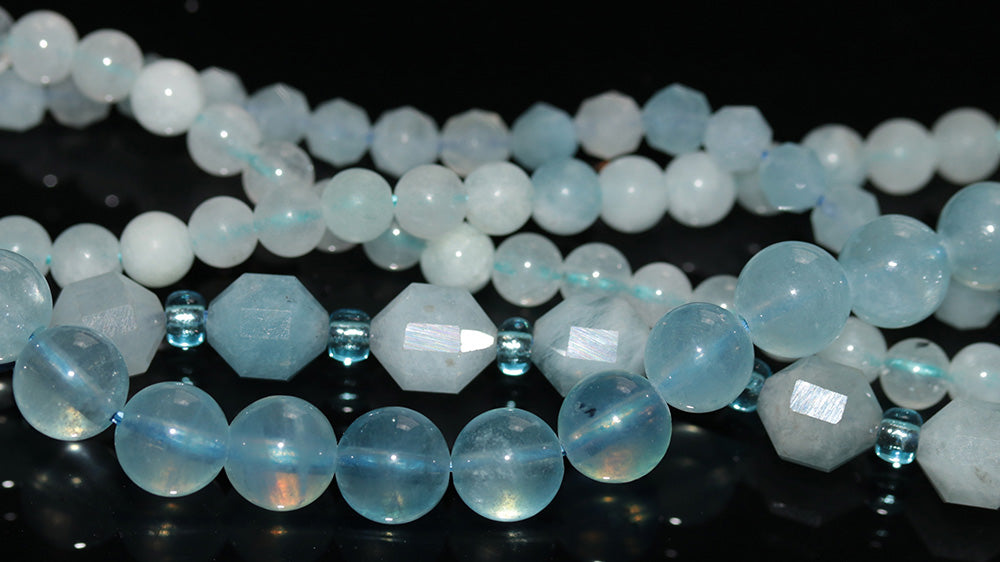
The soft blue of real aquamarine
Aquamarine is a pale, translucent sky-blue — clean and watery rather than deep. That soft clarity is the stone's signature, not a sign of low quality; bead aquamarine reads lighter than the saturated gems you see in rings, and that delicate blue is exactly why designers reach for it. It's natural beryl, the same mineral family as emerald, and most aquamarine is gently heated to clear the faint green out of the blue — a permanent, industry-standard step.
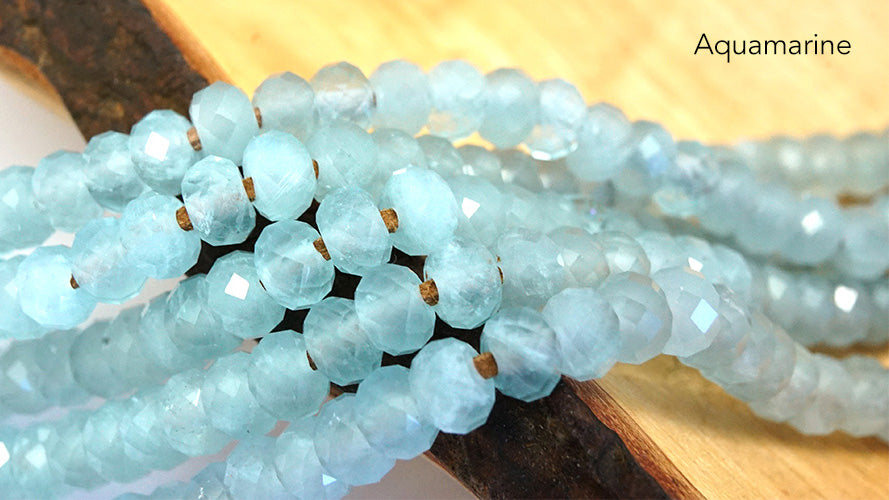
Cut to catch the light
Because aquamarine is a light-toned stone, the cut does the work of giving it life. Faceted rondelles and microfaceted rounds break up the light inside each bead, so a pale blue strand sparkles and reads brighter than a smooth polish would. Reach for faceted when you want movement and shine; smooth rounds give a calmer, more matte pastel. Either way the color stays soft and clear.
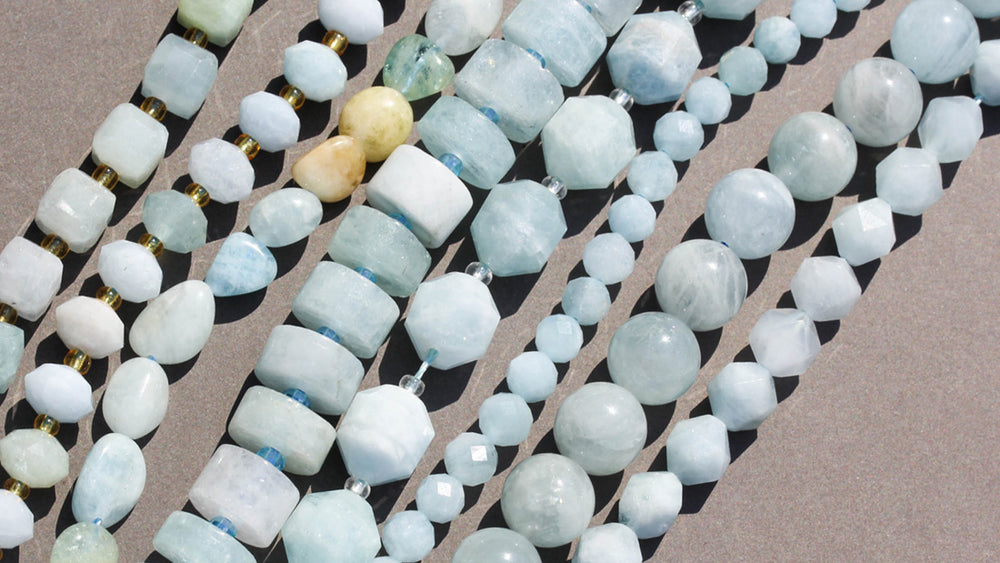
Pick your size and cut
Aquamarine is hard and wearable — Mohs 7.5–8, the same toughness as emerald — so it stands up to daily jewelry. It's stocked in small, refined sizes from 2–3mm accents through 6mm rounds, faceted and smooth, ideal for delicate strands and layering. Clean it with mild soap and a soft cloth. It layers naturally with labradorite and other cool blues and soft pastels.
About this stone
Color
Light BlueSky BlueVivid BlueGreenish-Blue (Santa Maria color)
Origin
BrazilMozambiqueMadagascarNigeriaPakistan
Mohs hardness
7.5–8
Treatment categories
HeatedNatural
Industry-standard treatment
Heat treatment
Mineral chemistry
Beryllium aluminum silicate (beryl)
Crystal system
Hexagonal
Stone family
Beryl
Birthstone
March
Common cuts
Faceted RondelleMicrofaceted RoundSmooth Round
Common sizes
2mm3mm4mm6mm
Care notes
Durable (Mohs 7.5–8). Ultrasonic and steam generally safe for clean material; avoid for fracture-filled strands.
Related stones
Emerald, Morganite, Tourmaline
Frequently asked questions
-
Is your aquamarine natural or heat-treated?
The vast majority of aquamarine on the global market is heat-treated to convert greenish rough to pure blue. The treatment is permanent, stable, and industry-universal. Heated strands should be labeled; untreated strands carry their own label when source material is known. Ask before buying if the page doesn't specify treatment. -
Is heat-treated aquamarine still real aquamarine?
Yes. Heat treatment changes the color of the rough but doesn't change what the stone is — it's still beryl. The treatment is the global industry default and has been since the early 20th century. Disclosure is the trade standard; treatment should be disclosed — ask if a strand doesn't specify. -
What does "Santa Maria color" mean?
It's the trade's name for the deepest, purest, most saturated blue tier on the aquamarine color scale — originally describing material from the Santa Maria de Itabira mine in Brazil. That mine is essentially exhausted; today, "Santa Maria color" is applied to any aquamarine that meets the same color benchmark, regardless of origin. Most current Santa Maria-color material is from Mozambique, Madagascar, Nigeria, or Pakistan. -
What's the difference between aquamarine and blue topaz?
They're different stones. Aquamarine is beryl (Mohs 7.5–8), with a softer, sometimes slightly greenish blue. Blue topaz is topaz (Mohs 8), almost always irradiated and heated colorless topaz, with a more saturated and often brighter blue. Blue topaz is significantly more abundant in supply than aquamarine. The two are not interchangeable, and "blue topaz" sold as aquamarine (or vice versa) is a labeling problem — mineral identity should be disclosed, so confirm if a listing doesn't specify. -
Why is aquamarine usually faceted instead of smooth?
Aquamarine's value comes from clarity and color, both of which are amplified by faceting. Smooth-polished aquamarine is uncommon at trade scale — the stone reads dull compared to faceted material of the same grade. Most bead-format aquamarine is microfaceted (small precision facets at 2.5–4mm) or faceted rondelle / round.