

Amethyst Gemstone Beads
Amethyst is the birthstone for February, making it a very popular gemstone. Dakota Stones carries a large selection of Amethyst gemstone beads ranging from 8 to 16 inch strands. Available in different sizes, facets and cuts, we are sure to have the right strand for you. These high-quality strands are perfect for designers looking for amethyst beads for jewelry making and creative DIY projects.
Facts: Amethyst has been linked to many different practices and beliefs. Due to its color, it was often prized in royal circles for symbolizing power. While the Ancient Greeks may have believe it prevented intoxication.
Metaphysical / Holistic: Many believe Amethyst brings a calming and protective sense, along with mental clarity. It is also said to be The Crystal for Love and Protection.


Amethyst Natural 6x8mm Table Cut Corner Drilled Cube Bead - 15-16 Inch
Original price
$35.00
-
Original price
$35.00
Original price
$35.00
$35.00
-
$35.00
Amethyst is a beautiful purple stone, known as a “Gem of Fire” by ancient cultures. It has been greatly sought after throughout history and was at ...
View full details
Original price
$35.00
-
Original price
$35.00
Original price
$35.00
$35.00
-
$35.00


Amethyst 7mm Cube Table Cut - 15-16 Inch
Original price
$41.00
-
Original price
$41.00
Original price
$41.00
$41.00
-
$41.00
Amethyst is a beautiful purple stone, known as a “Gem of Fire” by ancient cultures. It has been greatly sought after throughout history and was at ...
View full details
Original price
$41.00
-
Original price
$41.00
Original price
$41.00
$41.00
-
$41.00


Amethyst Natural 6-7mm Table Cut Cube A Grade Bead - 15-16 Inch
Original price
$39.00
-
Original price
$39.00
Original price
$39.00
$39.00
-
$39.00
Amethyst is a beautiful purple stone, known as a “Gem of Fire” by ancient cultures. It has been greatly sought after throughout history and was at ...
View full details
Original price
$39.00
-
Original price
$39.00
Original price
$39.00
$39.00
-
$39.00


Dog Teeth Amethyst 6-7mm Table Cut Cube Bead - 15-16 Inch
Original price
$28.00
-
Original price
$28.00
Original price
$28.00
$28.00
-
$28.00
Dog Teeth Amethyst has a purple and white striped appearance due to its combination of Amethyst and White Quartz. The name derives from the recurri...
View full details
Original price
$28.00
-
Original price
$28.00
Original price
$28.00
$28.00
-
$28.00
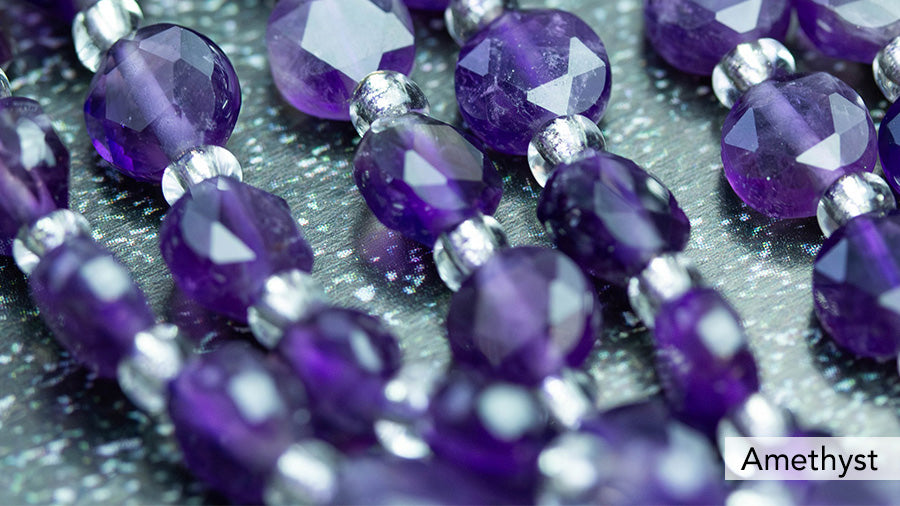
What good amethyst color looks like
Good amethyst is a clean, saturated purple — medium-to-deep grape, even from bead to bead, with little of the pale banding you find in cheaper rough. Ours is natural quartz, never dyed: the color runs all the way through the stone, not concentrated in the drill holes the way dyed material gives itself away. Every strand is graded and matched so the beads read as one set.
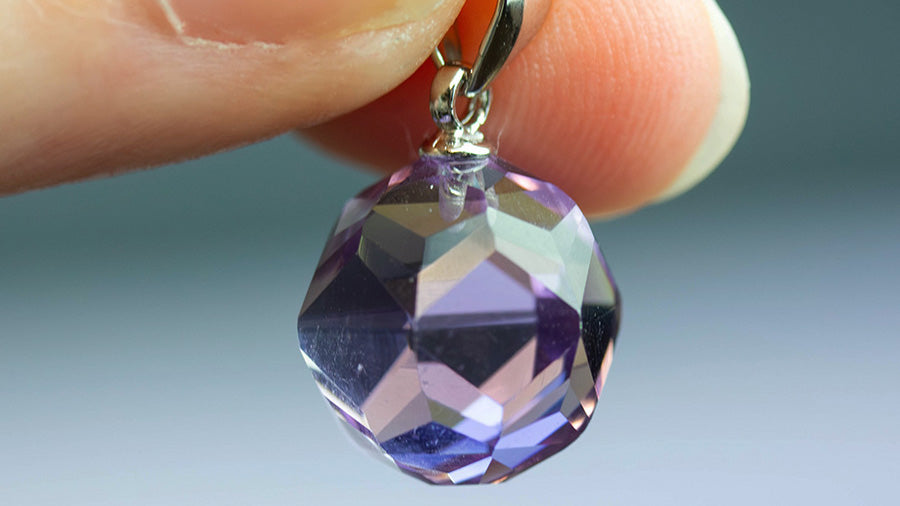
Why faceted amethyst reads richer
Amethyst is a medium-toned purple, so the cut does real work. Faceting breaks up the light inside each bead — it deepens the purple and adds a sparkle a smooth round can't. That's why a faceted strand looks more saturated than the same color polished smooth. Reach for faceted when a piece needs presence — evening, bridal, a focal; smooth rounds give a softer, everyday glow. Two finishes, two jobs.
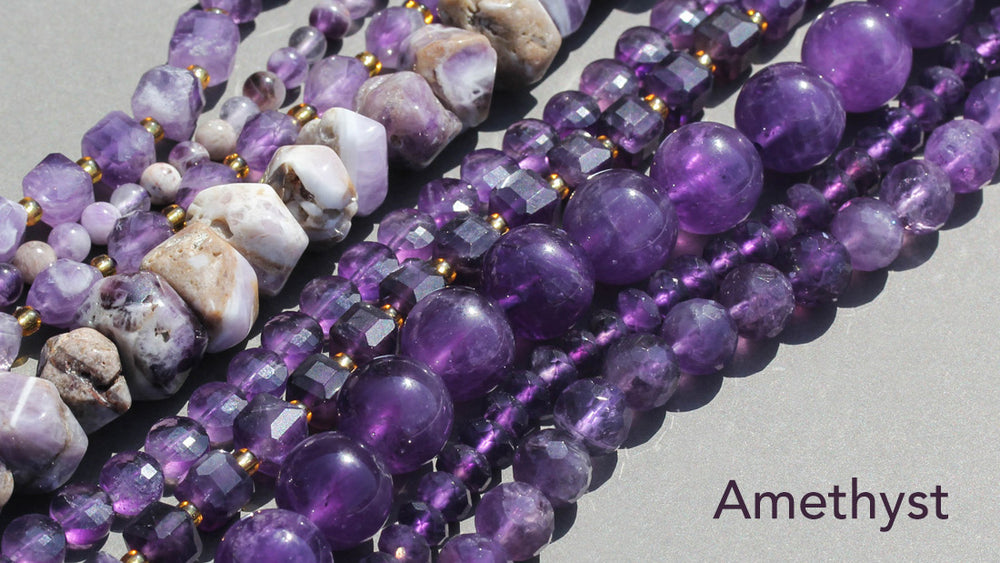
Built to be worn — pick your size and cut
At Mohs 7, amethyst is hard enough for rings and bracelets worn every day. It's stocked from 2–4mm accents through 8mm everyday rounds to 20mm+ statement beads — faceted, smooth, and rondelle — so you can match a finished piece or build a graduated set, all shipping in one order. Care is simple: some pale rough is heat-treated to deepen the purple (never dyed), so keep strands out of prolonged direct sun and clean with warm, soapy water rather than an ultrasonic. Amethyst pairs naturally with rose quartz and cool blues like lapis and apatite. Browse the full selection below.
About this stone
Color
LavenderPurpleDeep PurpleVioletReddish-Purple
Origin
BrazilUruguayZambiaMadagascarRussia
Mohs hardness
7
Treatment categories
NaturalHeated
Industry-standard treatment
Mostly natural; some pale rough heat-treated to deepen color (extended heat converts amethyst to citrine or prasiolite)
Mineral chemistry
Silicon dioxide (purple variety of quartz, colored by iron and natural irradiation)
Crystal system
Trigonal
Stone family
Quartz
Birthstone
February
Common cuts
Faceted RondelleRoundSmoothChipMicrofaceted Round
Common sizes
2mm3mm4mm6mm8mm10mm
Care notes
Durable (Mohs 7). Ultrasonic and steam generally safe for natural material; avoid prolonged direct sunlight which can fade amethyst over years.
Related stones
Citrine, Quartz, Ametrine, Rose Quartz
Frequently asked questions
-
Is your amethyst natural or heat-treated?
Most amethyst is natural — the purple is the color the rough was mined at. Some pale material is heat-treated to deepen color before stringing; when that's the case it should be disclosed. Synthetic (lab-grown) amethyst and dyed quartz labeled as amethyst exist in the broader market — confirm mineral identity before buying anywhere that doesn't list it. -
Is heat-treated amethyst still real amethyst?
Yes. Heat treatment changes the color of natural amethyst rough but doesn't change what the stone is — it's still iron-bearing quartz. The treatment is stable, industry-accepted, and meaningfully different from synthetic stones or dyed material. Disclosure is the trade standard; treatment categories should be disclosed — ask if a strand doesn't specify. -
What's the difference between Brazilian, Uruguayan, and Zambian amethyst?
Brazilian amethyst is the volume default — broad color range from pale to medium purple, mostly geode-formed. Uruguayan amethyst is also geode-formed but typically deeper-saturated — the classic "gelatinous" rich purple with red and blue flash. Zambian amethyst is vein-deposited rather than geode-formed and tends toward a saturated raspberry-purple; it's frequently the actual rough behind strands sold under the "Siberian color" label. -
Is "Siberian amethyst" really from Siberia?
Almost never anymore. The original Siberian deposits effectively played out decades ago. "Siberian" today is a color descriptor — deep purple with blue and red secondary flashes — that gets applied to the highest-saturation strands regardless of actual origin (typically Uruguayan or Zambian). -
Does amethyst fade in sunlight?
Prolonged direct sun exposure can fade amethyst color over time — months or years, not days. Normal indoor wear and reasonable display are not a problem. Store finished pieces away from sunny windows if long-term color stability matters for your design.