
Labradorite 8x11mm Leaf - 8 Inch
Original price
$99.00
-
Original price
$99.00
Original price
$99.00
$99.00
-
$99.00
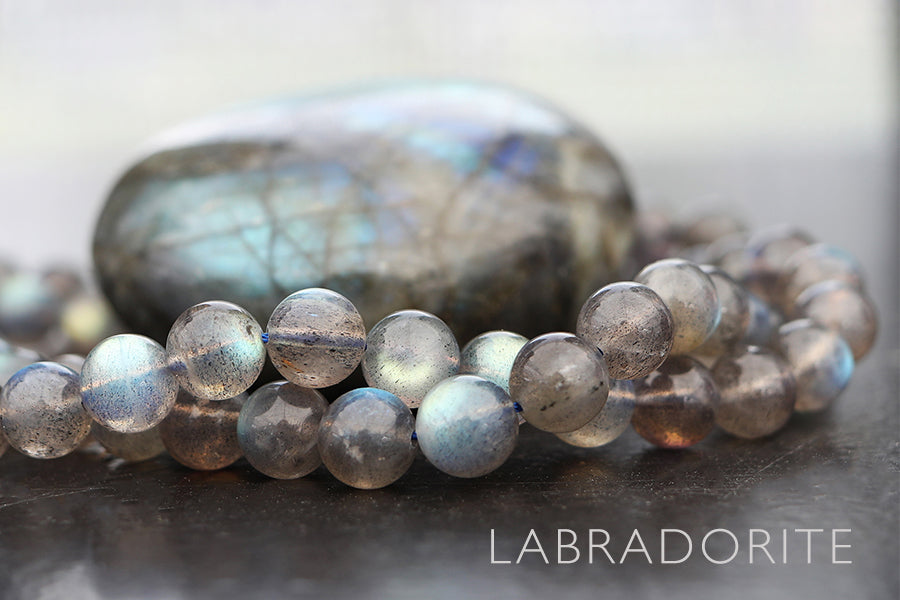
Labradorite is remarkable for the way its aggregate layers refract light, creating iridescent flashes of blue, gold, pale green or copper red. This effect is known as “labradorescence,” taking its name from the stone. Labradorite is usually gray to green, dark gray, light gray or black. It was discovered in Labrador, Canada in 1770 and named for the area, though it is referenced as a highly revered stone in much older Inuit tribal legends.
SKU LBT8x11LEAF
Specifications
Stone type
Feldspar
Strand length
8 Inch
Treatment
Natural
Typical origin
MadagascarCanada (Labrador)Finland (Spectrolite)Russia
Mohs hardness
6–6.5
Care
Mohs 6–6.5 with two cleavage directions. Avoid ultrasonic. Best in necklaces, earrings, pendants; use with care in rings and bracelets.
Mineral family
Feldspar
Frequently asked questions
-
What causes labradorite's flash, and why does it vary strand to strand?
Labradorite's signature flash — called labradorescence — comes from light scattering off internal twinning planes within the plagioclase feldspar structure. The effect is directional, so a bead only flashes when light hits the right angle relative to those internal layers. On a strand, you'll typically see strong flash on some beads, partial flash on others, and a few that read as plain gray until rotated. This is inherent to the material, not a quality defect. When designing, plan to orient high-flash beads at focal points and let quieter beads carry the rhythm of the piece. -
Is labradorite typically treated?
Labradorite is one of the feldspar varieties that reaches the bead trade in natural form — color and flash are structural, not added. You'll occasionally see coated or assembled novelty material (mirror-back doublets, AB-coated beads) marketed under labradorite-adjacent names, but standard drilled strands are untreated. Treatment status should be disclosed; ask before buying if it isn't specified. Because the flash is a light-interference effect rather than pigment, there's nothing to fade — color stability over time is excellent compared to dyed stones. -
How does labradorite hold up in rings and bracelets?
Mohs 6–6.5 puts labradorite in the same durability range as moonstone and amazonite — wearable, but with caveats. The bigger concern is cleavage: labradorite has two directions of good cleavage, meaning a sharp impact on a bead edge can chip or split it along an internal plane. That makes it well-suited to necklaces, earrings, and pendants, and workable for occasional-wear bracelets and cocktail rings. For daily-wear rings or stacking bracelets that take constant knocks, choose a tougher stone or protect the labradorite with bezel-style settings and spacer beads. -
How do I clean finished labradorite jewelry?
Wipe with a soft damp cloth and mild soap, then dry immediately. Skip ultrasonic and steam cleaners — vibration can propagate along the cleavage planes and chemicals can dull the polish. Avoid prolonged soaking, household cleaners, chlorine, and perfume contact, which can etch the surface over time. Store labradorite separately from harder stones (quartz, topaz, corundum) so the polish doesn't get scratched in a shared pouch. If the flash ever looks dulled, it's almost always surface film from skin oils or product residue, not damage — a gentle wipe restores it. -
What's the difference between labradorite, spectrolite, and rainbow moonstone?
All three are plagioclase feldspars with related optical effects. Standard labradorite — typically Madagascar or Canadian — shows blue, gold, or green flash on a gray body. Spectrolite is a trade name for Finnish labradorite that displays a fuller spectrum (reds, oranges, purples alongside blue and green) and tends to command higher prices. Rainbow moonstone is actually white labradorite — a near-colorless body with blue adularescence — sold under the moonstone name by trade convention. All share the same Mohs range and care profile, so designer-side handling is identical; the visual choice drives the selection.