
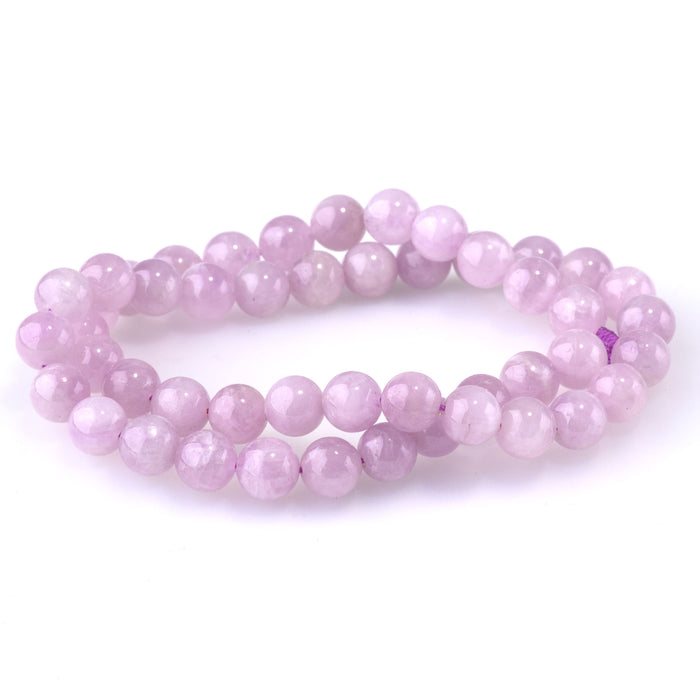


Kunzite 8mm Round AA Grade - 15-16 Inch
Original price
$58.00
-
Original price
$58.00
Original price
$58.00
$58.00
-
$58.00
Kunzite was named after a former Tiffany & Co. vice president, famed mineralogist and jeweler George Frederick Kunz, who first catalogued the stone in 1902. It is a variety of the silicate Spodumene, and forms naturally as a glassy, transparent stone. It can be colorless, pink, lilac, yellow or green, with darker shades being higher in value. Kunzite is prone to fading in direct sunlight.
SKU KUN8RD-AA
Specifications
Stone type
Spodumene
Cut
Round
Bead size
8mm
Strand length
15-16 Inch
Approx. beads per strand
45
Drill style
Center-drilled
Hole size
0.8-1.1mm
Grade
AA Grade
Typical origin
BrazilAfghanistanUSA (California)Madagascar
Mohs hardness
6.5–7
Care
Durable (Mohs 6.5–7) but has perfect cleavage; avoid sharp impacts. Store away from direct sunlight to preserve color.
Mineral family
Spodumene
Frequently asked questions
-
Does kunzite fade in sunlight, and how should finished pieces be stored?
Kunzite's pink-to-violet color comes from manganese and is known to fade with prolonged exposure to strong light, particularly direct sunlight and UV. The trade sometimes calls this the 'evening stone' for that reason. For finished pieces, store strands and jewelry in a dark drawer or pouch when not being worn, and avoid leaving them on a sunny windowsill or in a display case under hot lighting. Color shift is gradual rather than overnight, but designs intended for daily outdoor wear will hold color better in earrings or occasional-wear pendants than in pieces that live on the wrist in full sun. -
Is kunzite ever treated, and what does irradiation mean for the bead?
Kunzite is sold both natural and irradiated. Irradiation is used to deepen or restore pink-to-violet saturation in pale rough, and the treatment is stable under normal wear but does not change the stone's underlying light sensitivity — irradiated material can still fade with UV exposure. There is no surface coating involved, so the color is throughout the bead and won't wear off at drill holes. Treatment status should be disclosed; ask before buying if it isn't specified, particularly if you're pricing a piece where natural-color provenance matters to the end customer. -
Kunzite is Mohs 6.5–7 — why does it still need careful handling?
Hardness measures scratch resistance, but kunzite also has perfect cleavage in two directions, meaning it can split along internal planes from a sharp blow even though the surface resists scratching. For beadwork this matters most at the drill hole and at any point of impact: avoid tumbling finished pieces, don't drop strands on hard surfaces, and use bead caps or knotting between beads in necklaces to cushion bead-on-bead contact. Kunzite is well suited to earrings, pendants, and necklaces; it's a riskier choice for rings or bracelets that take regular knocks against desks and door frames. -
How do I tell kunzite apart from morganite and pink tourmaline?
All three show pink-to-peach-to-violet ranges and turn up in similar bead cuts, so visual ID alone is unreliable. Kunzite (spodumene) is strongly pleochroic — rotating a transparent bead often shows a shift between pink, violet, and near-colorless along different axes, more dramatic than morganite. Morganite (beryl) tends toward peachy or salmon pink and is more uniform when rotated. Pink tourmaline runs from hot pink to red and is typically more saturated. Refractive index and specific gravity are the definitive tests; for buying purposes, rely on the mineral identity listed in the specifications rather than color alone. -
What kinds of designs does kunzite work best in?
Kunzite reads as a soft, transparent-to-translucent pink-violet and pairs well with warm metals — rose gold and yellow gold flatter the pink, while sterling cools it toward lavender. It works alongside morganite, pink and peach moonstone, rose quartz, and rhodochrosite for tonal palettes, or against green stones like peridot, prehnite, and chrome diopside for complementary contrast. Smaller faceted rounds and microfaceted rounds catch light well in earrings and delicate strands; cabochons and larger rounds suit statement pendants where the pleochroic color shift is visible. Reserve it for pieces that won't live in direct sun to preserve saturation over the years.