
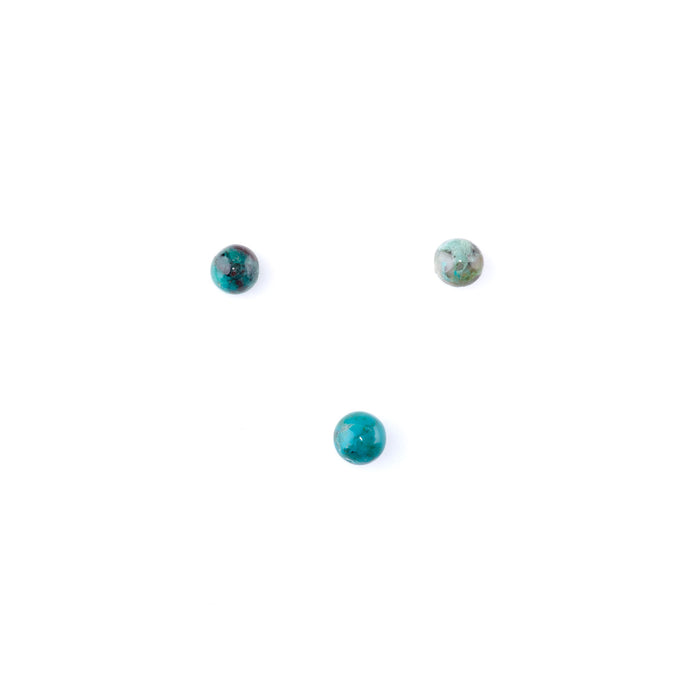


Chrysocolla 4mm Coin Cabochon
Original price
$5.00
-
Original price
$5.00
Original price
$5.00
$5.00
-
$5.00
Chrysocolla, a hydrous copper silicate, is often mistaken for turquoise due to its rich blues and blue-greens. It often also occurs with colors of rust, copper, black, white and reddish brown in speckles, veins and brecciated patterns. It is a very soft stone typically found near copper deposits. Chrysocolla was first described by Theosphrastus, a Greek philosopher and botanist who also named the stone, in 315 BCE.
SKU CAB-CHR4DC
Specifications
Stone type
Silicate
Cut
Cabochon
Bead size
4mm
Drill style
Undrilled focal stone (bezel-set); some side-drilled or back-drilled
Treatment
Stabilized
Typical origin
PeruUSA (Arizona)ChileDemocratic Republic of CongoIsrael
Mohs hardness
2.5–4 (3.5–7 when silicified with quartz)
Care
Soft variety can be very fragile (Mohs 2.5); silicified material is durable (Mohs 6–7). Mild soap and soft cloth; avoid ultrasonic and harsh chemicals.
Mineral family
Silicate
Frequently asked questions
-
Is chrysocolla naturally this soft, and what does that mean for stringing?
Pure chrysocolla is genuinely soft — Mohs 2.5 to 4 — which is why most bead-grade material is either stabilized with resin or naturally silicified (intergrown with chalcedony or quartz, pushing hardness to 6–7). Silicified chrysocolla, sometimes traded as chrysocolla chalcedony or gem silica, handles stringing, polishing, and wear far better than unstabilized soft material. Treatment and silicification should be disclosed — ask before buying if it isn't specified. For knotted strands, stretch cord, or kumihimo, either form is workable; for tight bead-weaving with sharp thread tension, lean toward silicified or stabilized stock. -
What's the difference between chrysocolla, malachite, azurite, and Eilat stone?
All four are copper minerals and often appear together in the same deposits, which is why they get confused. Chrysocolla is a hydrated copper silicate, typically sky blue to blue-green, often chalky when untreated. Malachite is copper carbonate, deep green with banded patterns. Azurite is also copper carbonate but vivid blue, frequently found alongside malachite. Eilat stone is a natural mixture of chrysocolla, malachite, azurite, and turquoise found in Israel — sold as a single trade material rather than a distinct mineral. If color zoning runs blue-green-green-blue in one bead, you're likely looking at Eilat or a chrysocolla-malachite composite. -
How do I care for finished jewelry made with chrysocolla?
Skip the ultrasonic, steam cleaner, and any ammonia, bleach, or acidic cleaner — copper minerals react with chemicals and the softer chrysocolla matrix can pit or dissolve. Clean with a soft cloth and, if needed, mild soap and a damp cloth followed by immediate drying. Store separately from harder stones like quartz, topaz, or sapphire to prevent scratching. For unstabilized soft material, treat finished pieces as occasional-wear: earrings, pendants, and necklaces hold up; rings and bracelets see too much abrasion. Silicified chrysocolla tolerates daily wear in protective settings. -
What jewelry projects does chrysocolla work best for?
The turquoise-to-teal palette pairs naturally with sterling silver, oxidized silver, and copper findings — the warm metal tones echo the mineral's copper origin. Chrysocolla reads as a softer, more painterly alternative to turquoise, with cloudier color zones and frequent matrix inclusions. It plays well with malachite, lapis, hematite, and pyrite in Southwest-influenced or earth-tone designs. Smaller rounds (4–6mm) suit multi-strand and bead-woven work; 8–10mm rounds and cabochons anchor statement pieces. Faceted and microfaceted cuts add light return that smooth rounds don't, useful when the color runs paler. -
Why does chrysocolla color and pattern vary so much between strands?
Chrysocolla forms in copper oxidation zones, so the surrounding minerals — quartz, malachite, azurite, cuprite, native copper — get incorporated into the rough. Peruvian material often shows bright robin's-egg blue with black matrix. Arizona chrysocolla can run more green-blue and frequently appears silicified. Congolese material trends toward darker blue with malachite banding. Chilean and Israeli (Eilat) stock typically shows mixed copper-mineral patterning. Even within a single strand, beads can vary in saturation and matrix density because rough is cut for yield rather than uniformity. Origin should be disclosed when known — expect strand-to-strand variation as a feature of the material.