
Skip to content

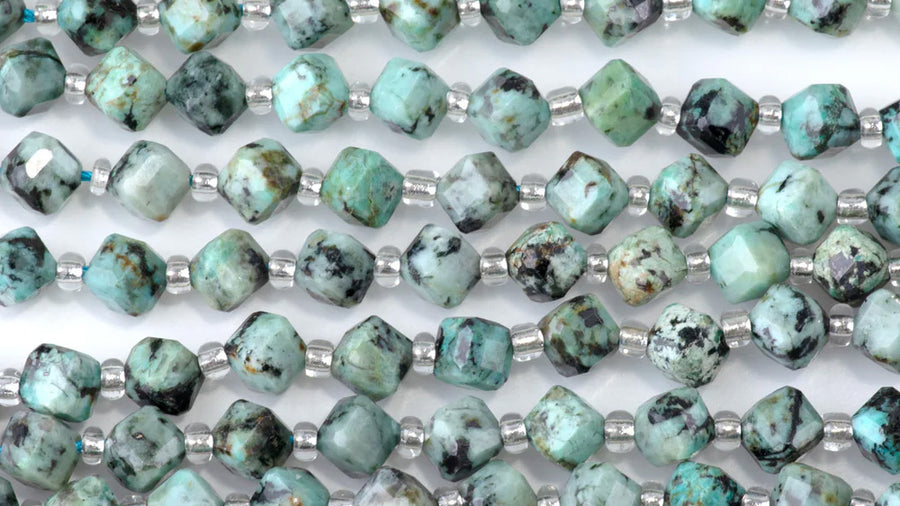
African Turquoise 4mm Microfaceted Round - 15-16 Inch

Original price $13.00 - Original price $13.00
Original price $13.00
$13.00 - $13.00
Current price $13.00
Login for wholesale

African Turquoise is not actually Turquoise, but rather a speckled teal Jasper found in Africa and often treated to simulate the beautiful blue to green associated with true Turquoise. It contains inclusions such as copper and iron, creating veins and mottling that ranges in color from rust to black. Considered a stone of transformation and evolution, it is believed to awaken those who carry it to their highest spiritual purpose.

SKU ATQ4RD-F
Specifications

Stone type
Jasper
Cut
Microfaceted round
Bead size
4mm
Strand length
15-16 Inch
Approx. beads per strand
100
Drill style
Center-drilled
Treatment
Stabilized
Typical origin
Africa
Mohs hardness
6.5–7
Care
Durable (Mohs 6.5–7) but dyed surface may abrade with harsh chemicals. Mild soap and soft cloth.
Mineral family
Jasper

Frequently asked questions

  • Is African Turquoise actually turquoise?
    No — "African Turquoise" is a trade name for a spotted jasper (microcrystalline quartz) mined in Africa. It is not chemically related to turquoise, which is a hydrated copper-aluminum phosphate. The name comes from the stone's mottled blue-green appearance, which resembles turquoise matrix. For bench designers this distinction matters mainly for client disclosure and pricing context — African Turquoise is a jasper-family material at jasper Mohs hardness (6.5–7), not a phosphate. If a customer asks for "turquoise," clarify which material they want before pricing the piece.
  • Is African Turquoise dyed, and does the color hold up?
    The blue-green color in African Turquoise is typically enhanced through dyeing, and many strands are also stabilized to firm the surface for drilling and polish. Treatment should be disclosed — ask before buying if it isn't specified. Dyed surfaces generally hold well in finished jewelry but can abrade or lighten with prolonged exposure to acetone, alcohol-based cleaners, perfume, and ultrasonic cleaning. Stick to mild soap, lukewarm water, and a soft cloth. Avoid storing dyed jasper against light-colored leather or fabric where any color migration would show.
  • What kinds of projects suit African Turquoise best?
    At Mohs 6.5–7, African Turquoise handles bracelets, necklaces, earrings, and most stringing applications without unusual fragility. The dense black and rust speckling reads well at 8mm and up, which is why those sizes dominate the stocked range — the pattern gets lost much below 6mm. Round and coin cuts show the matrix; faceted rondelles add sparkle while keeping the earthy palette. It pairs cleanly with brass, antique copper, raw bronze, leather cord, wood, bone, and other jaspers. For boho, southwestern-inflected, and men's designs it carries the visual weight of turquoise at a working price point.
  • How do I tell African Turquoise from real turquoise on the bench?
    Real turquoise typically shows a softer, waxier luster, a narrower hardness range (around 5–6), and matrix that follows fracture lines rather than scattered spots. African Turquoise, being jasper, takes a harder polish, feels denser, and shows the speckled pyrite-like inclusions and black flecking distributed through the body of the stone. Color tends toward muted teal and green-gray rather than the saturated robin's-egg blues seen in Sleeping Beauty or Kingman material. When in doubt, hardness and specific gravity will separate them — jasper scratches glass cleanly; most turquoise will not.
  • What other stones get confused with African Turquoise?
    Several jaspers share the spotted, earth-toned look: regular spotted jasper, Impression Jasper, and some dyed magnesite or howlite marketed under invented "turquoise" trade names. Chrysocolla-in-quartz and some variscite material can also resemble it from a distance. The reliable tell for African Turquoise is the combination of jasper hardness, a green-to-teal body color, and dense dark speckling distributed throughout rather than concentrated in veins. If a project calls specifically for jasper-family material or specifically for phosphate turquoise, confirm the mineral identity before ordering.