
Skip to content

African Turquoise (AAA) 8mm Round 15-16 Inch

Original price $36.00 - Original price $36.00
Original price $36.00
$36.00 - $36.00
Current price $36.00
Login for wholesale

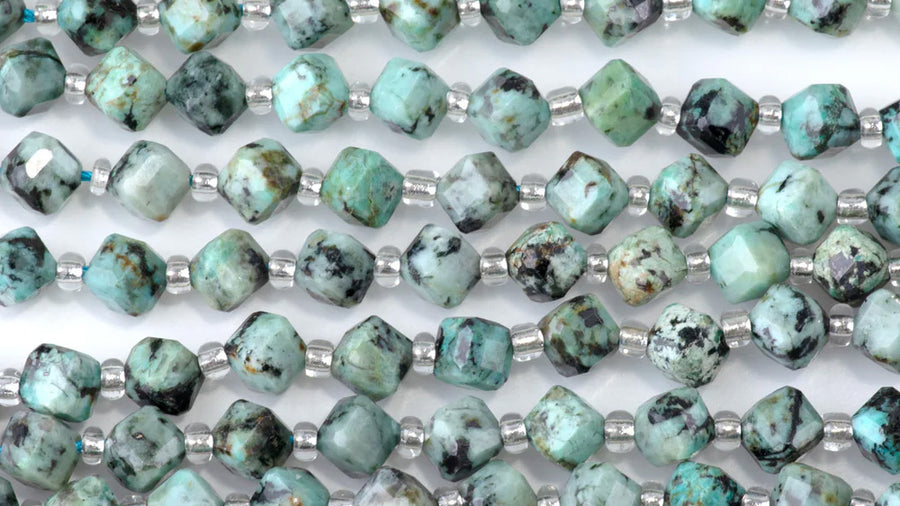
African Turquoise is not actually Turquoise, but rather a speckled teal Jasper found in Africa and often treated to simulate the beautiful blue to green associated with true Turquoise. It contains inclusions such as copper and iron, creating veins and mottling that ranges in color from rust to black. Considered a stone of transformation and evolution, it is believed to awaken those who carry it to their highest spiritual purpose.

SKU ATQ8RD-AAA
Specifications

Stone type
Turquoise
Cut
Round
Bead size
8mm
Strand length
15-16 Inch
Approx. beads per strand
45
Drill style
Center-drilled
Treatment
Stabilized
Typical origin
USA (Arizona)USA (Nevada)China (Hubei)Mexico
Mohs hardness
5–6
Care
Avoid ultrasonic, steam, bleach, and household cleaners. Soft damp cloth only. Remove before swimming, gym, perfume, hand-washing.
Mineral family
Turquoise

Frequently asked questions

  • Is this real turquoise or a dyed substitute?
    Material sold under the Turquoise name in this collection is hydrated copper-aluminum phosphate — the genuine mineral. The bead trade also sells dyed howlite and dyed magnesite under names like 'white turquoise' or 'turquenite,' which are not turquoise. Dyed quartz and reconstituted blocks also circulate. If a strand is composite (reconstituted from turquoise powder and binder) or block-pressed, that should be noted in the product title or specifications. When the descriptor is just 'Turquoise' with a stated treatment (natural or stabilized), you are buying the mineral itself — ask before purchase if anything is unclear.
  • What does 'stabilized' mean for turquoise, and is it expected?
    Stabilization is the industry standard for most turquoise on the market. Raw turquoise is porous and often chalky; stabilization infuses the stone with a clear resin or polymer to harden it, lock in color, and make it workable as beads without crumbling at the drill hole. Stabilized turquoise is still turquoise — only the porosity is filled. Untreated natural turquoise exists but is uncommon in calibrated bead strands and priced accordingly. Composite or reconstituted material is a separate category and should be labeled as such. Treatment should appear on the product page; ask before buying if it isn't specified.
  • How do origin and color vary across Dakota's turquoise?
    Hubei (China) turquoise runs from sky blue to robin's-egg with brown or black matrix and is the most consistent in calibrated bead sizes. Arizona material (Sleeping Beauty type and Kingman type) tends toward clean blue with reddish-brown or no matrix. Nevada turquoise often shows green tones and spiderweb matrix. Iranian (Persian) turquoise is classic sky blue, sometimes with golden limonite matrix. Mexican turquoise varies widely. Origin should be noted in the product title or specifications when known — color and matrix vary strand to strand even within one mine, so pictured strands are representative.
  • How do I care for turquoise in finished jewelry?
    Turquoise sits at 5–6 on Mohs and is chemically reactive — it absorbs oils, perfumes, lotions, sweat, and chlorinated water, which can turn blue stones green or dull the surface permanently. Stabilized strands tolerate handling better than untreated, but care is the same: wipe with a soft, slightly damp cloth and dry immediately. No ultrasonic, no steam, no bleach, no jewelry dips. Remove before swimming, the gym, hand-washing, and applying fragrance or sunscreen. Earrings and necklaces wear better long-term than rings or bracelets, which take more abrasion and skin contact.
  • What scale and cut works best for turquoise in design?
    Small rounds (3–4mm) and microfaceted rounds read as classic accent strands and pair cleanly with sterling, gold-fill, coral, lapis, and pearl. Heishi and tyre cuts give the Southwest profile and stack well with sterling spacers. Pebble and nugget shapes show off matrix patterning and work for statement pieces where each bead reads individually. Cubes and rondelles bridge between geometric and organic looks. Because color and matrix vary across mines and even across one strand, designers stringing multi-strand or graduated pieces should buy enough material from a single order to keep the palette consistent.