
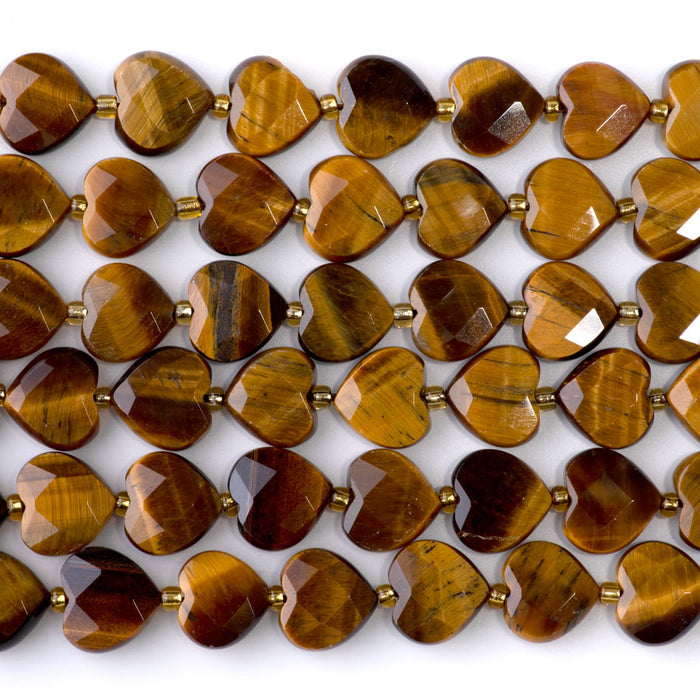

Yellow Tiger Eye 12mm Faceted Heart - 15-16 Inch
Original price
$38.00
-
Original price
$38.00
Original price
$38.00
$38.00
-
$38.00
Tiger Eye is a macrocrystalline Quartz stone with bands of rich golds and browns. Its chatoyant layers that create a flash which seems to emanate from within the stone as they catch the light. Tiger Eye has been revered and feared throughout history as an all to seeing, all to knowing eye, as well as a stone of prosperity, protection and good fortune.
SKU TGE12HRT-F-YLW
Specifications
Stone type
Quartz
Cut
Heart
Bead size
12mm
Strand length
15-16 Inch
Approx. beads per strand
30
Drill style
Top-drilled (pendant) or center-drilled
Hole size
0.8-1.1mm
Treatment
Natural
Typical origin
South AfricaAustraliaNamibiaIndiaUSA
Mohs hardness
6.5–7
Care
Durable (Mohs 6.5–7). Mild soap and soft cloth.
Mineral family
Quartz
Frequently asked questions
-
What causes the chatoyant stripe in tiger eye?
Tiger eye is silicified crocidolite — parallel quartz fibers that pseudomorphed after asbestiform amphibole, with iron oxide staining producing the gold-to-brown color range. When the stone is cut with the fibers running parallel to the bead's surface, light reflects off them in a single moving band, the same optical effect (chatoyancy) seen in cat's eye chrysoberyl. On round beads the band shifts as the strand rotates; on cabochons and coins the effect is strongest because the cutter can orient the dome to maximize the flash. Faceted cuts break the band into smaller flickers across each face rather than one continuous stripe. -
Is red tiger eye natural or heat-treated?
Most red tiger eye on the market is heat-treated — controlled heating oxidizes the iron content from yellow-brown goethite toward red hematite, deepening the body color while preserving the chatoyancy. The treatment is stable, permanent, and standard in the trade; it doesn't affect durability or care. Natural red tiger eye exists but is uncommon. Gold and brown tiger eye is typically untreated. Blue tiger eye (hawk's eye) is the unoxidized parent material and is also generally natural. Specific treatment for a SKU should be disclosed — ask before buying if it isn't specified. -
How does tiger eye hold up in rings and bracelets?
At Mohs 6.5–7, tiger eye wears like the quartz family it belongs to — agate, chalcedony, jasper — though the fibrous structure can show fine parallel scratches along the chatoyant direction after years of hard wear. Earrings, pendants, necklaces, and bracelets are all comfortable territory; for daily-wear rings, expect the polish to need a little more care than a smooth solid quartz. Clean with mild soap and a soft cloth; skip ultrasonics, steam, and prolonged water soaks, which can work into the fiber structure. -
What's the difference between tiger eye, hawk's eye, and pietersite?
All three share the same fibrous quartz-after-amphibole structure. Hawk's eye is the blue-gray unoxidized form — the fibers haven't been chemically altered to the iron oxides that produce gold tiger eye. Pietersite is a brecciated mix of tiger eye and hawk's eye fibers in a chaotic, swirling pattern rather than parallel bands, giving it a stormy multi-directional flash; it's primarily Namibian and Chinese. Cat's eye in the bead trade usually refers to manufactured fiber-optic glass, not the chrysoberyl gem — that material is glass, not stone, and behaves very differently in stringing. -
Which cuts and bead sizes work best for which projects?
Smooth rounds (4–12mm) are the workhorse — the unbroken curve carries the chatoyant band cleanly and pairs well with brass, antiqued silver, leather, and warm-tone seed beads. Larger 12–14mm rounds and coins read as focal beads on men's bracelets and longer necklaces. Faceted rounds and coins break the band into flickers, which suits more contemporary settings and earrings where light movement matters more than a single stripe. Rondelles work as spacers between larger focal beads. Cabochons are oriented for maximum chatoyancy and are best for bezel-set pendants and rings rather than stringing.